Sunday, December 28, 2014

Protecting Your Idea?

ForewordOver the years I have generated numerous ideas, researched technologies and markets, and developed business plans. Some very viable and others not so viable. These matured ideas have been closely held as I watch for potential opportunities and fits. I don't see a need for a rush to market as there rarely is ever a need to rush. No perceived competitors are developing my ideas. I compete against myself unless I let out my ideas for other to develop. Nonetheless, I learned a few things along the way and would like to share them at this time.

Protecting Your Idea

‘Necessity is the mother of invention’ is an age old axiom that utterly gets it wrong because people rarely think of the invention necessary to fulfill some need. This does happen for example with the squeezable ketchup bottle which is not really an invention since the ketchup bottle and pliable materials already existed but not in combination. Instead, the squeezable bottle was an improvement, an innovation, as pliable materials were applied to a need to dispense ketchup. Inventions are something entirely new and create markets where nothing existed before. For example, the invention of the light bulb created new markets altogether. No one was asking for a light bulb as it was not in the minds of people. The light bulb was a phenomenon known as creative destruction where the new creation replaced the older creation, oil lanterns. The light bulb was also in service to humanity because it was safer than an oil lantern and was smokeless increasing possible placement options. More accurately ‘Invention is the mother of necessity’. Once introduced to the light bulb, people needed the product leading to markets for lighted signs, traffic signals, stylish lamps, ect... (Schwartz, 2004, p 13).  Ideas mature into inventions and/or innovations.

Everyone has ideas which are a dime-a-dozen. In many respects, ideas are like opinions which are unsupported beliefs that people hold with a high degree of confidence and esteem.  After all, they thought of the idea. An idea has no redeemable or measurable value in practice which is called utility. Therefore, an idea has nothing to protect, no utility. Utility is coupled closely with design having three elements; behavioral, sensation, and reflective. Utility in these three elements varies. Behavioral utility refers to the effectiveness of the design or the ability to perform work and is most often tangible. Sensation utility is artful invoking the senses or some sort of sensory experience. ie it is pleasing to the eye. Reflective utility centers on the story or message communicated.

When an idea is developed into a mature concept then that can be protected. A mature concept involves developing the idea into something that has economic value and is unique due to one's work, knowledge, and skills. A mature concept is said to have utility. At this point, the idea then becomes what is known as intellectual property. The challenge then becomes how does one introduce intellectual property in a public forum to a tightly held small group or to a larger constituency without losing control of the rights to the intellectual property? There are a few practical things that one can do which will be discussed.

First, realize that any business engagement should be shrouded in a legal blanket at some level based on the assessed risk. Of course, hiring an intellectual property attorney with all the associated cost and protection to oversee the entire process is ideal but not practical for the person who has limited resources while pursuing opportunity under the American dream. Each person should assess risk early and continuously. There is a process to developing then leveraging intellectual property for profit which begins with answering several questions.
  1. Does your product or service offer exceptional utility at an attractive price?
  2. Can product or service be delivered profitably within the organizational framework?
  3. Does the innovation/invention cause a disruptive shift?
The three questions center on the designs ability to not only produce revenue but do this in an attractive manner yielding low cost and new markets leading to profits. This is where the design must focus. Selling the design to prospects is more about mobilizing minds or convincing prospects to buy verses rejecting the design or stealing the design concept. When the design is good but the price is unattractive minds tend to think of ways to perform the same result at a lower cost. Prospects are more inclined to buy if the price, design, and effort for them are all attractive. Achieving this balance is an art in itself that begins with a process that has several steps to become organized into order to present.

1.  Develop an engagement plan. Such a plan will document the objectives of the design and engagements as well as provide schedules, prospect qualities, identify controlled information, set milestones, etc… The plan will vary based on the design concept and circumstances but should wrap around the entire effort organizing thoughts. Remember though that technology will always drive the schedule. Setting milestone dates instead of milestone achievements could create an optic of being late when dates are missed because the technology was not cooperating.

2.  Organize a team. Do not go at this alone. Become surrounded disciplinary experts. These experts do not have to be full time employees nor costly professional services. Services like SCORE under the Small Business Administration and small business incubators or development centers are available to nearly every city. Leverage these resources. When meeting with prospects at a minimum let them know about key team members such as CPAs and Attorneys. Arriving at the table having had CPAs and attorneys even engineers behind you can give a polished optic.

3.  Do the due diligence and study prospects. Study the prospects closely and learn their capabilities, capacities, and strategies. Understand the industry and business. Couple everything to the prospect’s direction, strategies, and operations highlighting advantage and earnings. Likewise, if a prospect turns out to be not a good fit then do not pursue them. Have standard evaluation criteria and seek performance measurements.  

4.  Create a Buzz. After becoming established and setting the necessary legal protections. Leverage social media and other media channels to create a buzz about the design concept. Have the market back pressure suppliers for the concept. Look for reflected messages and chatter. This can be a greater selling point than any face-to-face presentation as market demand drives demand for the concept.

5.  Prepare preliminary documents and presentations. Carefully craft the presentation as there can be legal repercussions. Documents like prospectus, forecast, pro-forma financial statements, ect… can be misinterpreted if ambiguous or if there is perceived innuendo. In preparing the documents use a rating system to classify information by paragraph. Such a rating system should include public, private, and closely held information. Avoid using any jargon or language that could be confused with the federal government’s classification system.

6. Meet with prospects. Face-to-face meetings are extremely important. A well designed and rehearsed presentation that does not go too deep but tickles their hot buttons should not exceed 30 minutes. Public and private information should be released after there are proper legal controls in place. Avoid releasing anything closely held until more advanced meetings and stronger legal protections.

7.  Negotiate wisely. Negotiations are always a challenge. The current mantra in most negotiations is Win-Win and empowerment. Win-Win is about putting everything on the table then finding the winning solution for both parties. Search out high value/low cost concessions. Find options to expand the pie for mutual gain. Know the best alternatives to a negotiated agreement. Empowerment is allowing the other person to have optimal control of their circumstance. This is a key in negotiations as a person convinced against their will remains unconvinced. Do not yield to pressure but work amicably, exploring all options. All negotiations are performed in good faith based on common objectives.

8. Get a signed formal agreement then maintain the agreement. Getting prospects to sign an agreement, contract, an engagement letter, a non-compete, a non-disclosure etc… is a difficult challenge. There needs to be some sort of formal understanding that is drafted by competent legal services and signed by the parties before a major dispute arises. A common strategy or tactic of many professionals in business is to enter into a relationship and then find a problem to exploit in order to strengthen their position. These situations need to be locked down but not in a manner that incites a negative response from the prospect. Once signed, the agreement should be properly filed. Follow up is necessary to ensure that payments are being made in a timely manner with accurate amounts; are milestone being met, and is there any sort of assistance necessary. Showing involvement and interest opens up new opportunities.

Protecting intellectual property requires much more than just a legal document written and oversaw by an attorney. Protecting intellectual property centers on relationship management and requires a well thought out plan, presentations, and controls. The controls need to be properly timed as walking in with documents that need to be immediately signed is often met with hesitation. The relationship needs to be developed without releasing or distributing critical information. This often involves sitting in on meetings, discussing the business, and socializing one’s self before presenting any intellectual property. Each prospect is different and requires a keen eye. In the end, you will need to make judgment calls balancing risk and progress. The goal is to work in a manner where everyone succeeds and everyone is comfortable.

References:

Bryan, L., & Joyce, C. (2007). Mobilizing Minds: Creating Wealth from Talent in the 21st Century. USA: McGraw-Hill.

Christensen, C., & Raynor, M. (2003). The Innovator's Solution: Creating and Sustaining Successful Growth. USA: Harvard Business School Publishing Corporation.

Kim, C. W., & Mauborgne, R. (2001). Knowing a Winning Business Idea When You See One. Harvard Business Review on Innovation, 77-102.

Neumeyer, C. (2014). 10 Tips For Successful OutBound Technology Licensing. Retrieved from Avvo: http://www.avvo.com/legal-guides/ugc/ten-tips-for-successful-outbound-technology-licensing

Schwartz, E. I. (2004). Juice: The Creative Fuel that Drives World-Class Inventors. Boston: Harvard Business School Press.

Sullivan, P. H. (1998). Profiting from Intellectual Capital: Extracting value from innovation. USA: Wiley and Sons, Inc

Wednesday, December 24, 2014

The Generalist: A Valued Professional

Foreword: This is a contributing article to the Job Search Featured Posts. The dialectic struggle between the specialist and generalist has been raging for decades if not longer and a very misunderstood struggle too. During the 1980's being a specialist was taboo and limiting. As economies contract and jobs become more difficult to find, then the specialist increase in importance. Also head hunters will almost always seek specialist as they are easier to place in specific roles. The generalist is rarely ever fresh out of school but instead the specialist matures into generalist roles with experience and deliberate planned career tracks. Becoming a generalist is not by accident.

Organizations heavy on specialist suffer terrible fates after becoming too polarized and myopic. A balance between generalist and specialist is needed in most organizations. This post discusses the debate and outlines the value of generalist in the workplace. Then offers advice on how  companies can utilize the generalist.

Specialist Verses Generalist

The debate regarding Specialist verses Generalist ping-pongs around like Disney's flubber. Surveys of articles on the subject focus predominantly on earning potential and job availability for specialist and tend to ignore or dismiss the generalist altogether. Most of the articles and thinking were initiated by placement agencies in this debate having a heavy bias towards the specialist niche market and demonstrated a misunderstanding of the generalist professional.

The specialist is more common. They are journeyman in a trade, go to a vocational school, or train in a two or four year college on a specific skill set. Often specialists are certified by the industry, government, or vendors. Specialists are in trades like plumbers, electricians, carpenters, software programmers, customer service agents, realtors, insurance agents, engineers, accountants,  and many other careers of the like. The term tradecraft, craftsmen, and workmanship all describe the time earned skills or experiential training acquired to be a specialist. Specialists are in high demand as employment tends to be readily available and placement agencies can more easily place candidates who show longevity in the trade. However, specialists are also subject to supply-side economics. If there are too many in a particular field then the wage goes down and employment becomes difficult to find. The skill sets are also subject to obsolescence due to disruptive technologies and shifting economies. Economic forces of capital economies such as creative destruction drive change in which the specialist can become obsolete in time. For example, typewriter repairmen are hard to come by following the personal computing revolution. The specialist is task oriented.

The generalist is a different character altogether. Most generalist originate from the ranks of specialist as the generalist is often trained in a trade, possess certifications, and degrees. Most generalist possess advanced degrees. However, this alone does not define the generalist. Experience and character are greater defining qualities of the generalist. True generalists start out as specialist then begin acquiring a very broad base of experience across sectors, industries, and disciplines. Becoming a generalist shifts focus from a task orientation to big picture, broad processes, and strategies. The character of generalist begins to morph towards innovator, motivator, and visionary. The generalist can see the end state and step in where needed to move the process along. They may not be as concise or skilled as a specialist but the generalist can get the ball rolling turning over to a specialist if needed while maintaining the focus on cost, profit, goals, and objectives.

The challenges

Companies rarely realize the need for a mix of specialist and generalist viewing the generalist as taboo without fully understanding the generalist value. One challenge is that during austere financial times, companies focus more heavily on specialist as the focus shifts to sustaining current relationships and business. The thinking is improving time-to-market and quality in order to keep existing customers happy. The perception is that specialist have honed skill sets who get the task done quickly. Also the specialist becomes a filter mechanism or gauge for new hires based on longevity in the trade. 

Another challenge for generalist to overcome is the commoditization of skill sets usually through certification programs. Many professional organizations are producing certifications centering on a specific set of skills, a specialty, such as supply chain, project management, logistics, lean, TQM, Six Sigma, etc... Commoditization is not generally thought of as a good thing as it means earnings marginalize or wages go down. Many people complete school with degrees in psychology, history, or general studies and are unable to find work. They obtain a specialty certification in order to improve their employment prospects. Companies observe the specialty certifications then hire those specialists who subsequently promote into influential positions while maintaining the specialty focus. This exasperates the situation for the organization since the specialist has not rounded themselves out in ways that benefit the organization as would the generalist. 

The value of having generalist is the ability to maintain the broad scope organizational focus which gets lost when too many specialist are present. An indicator of having too many specialists is when the staff performs their duties without an acute awareness of the value of their contribution towards profitability and the goals of the organization. The possibility exists that well intentioned specialist have built an overtly and unnecessarily complex operation that serves some specialty but fails to serve the organizational objectives. This can be averted with a balance between generalist and specialist of which the balance is unique to each company.

Identifying The Right Generalist Type

Companies typically fall somewhere into the STaRS model. STaRS stands for Start up, Transitioning, Reorganizing, or Sustaining. Some organizations claim to be in all four modes simultaneously. If that is the case then the organization is in absolute disarray lacking quality leadership. Nonetheless, the mode of the organization will drive the talent required. Executive admins are most often trained to be generalists but the generalist should occur at lower levels in managerial and directorial roles as well. In many cases, generalist are found in analytical roles, advisory roles, or leading think tanks. However, not all generalist are the same. Each has a mix of experiences and training that form generalist focus areas and match up to the organizations mode. Three common generalist focus areas follow:
  • Entrepreneurial: This generalist is rounded in finance, operations, and information technologies plus well read and versed in emerging technologies, theories, and concepts. They have character traits that include charismatic leadership, insight, and vision and are enablers who put vision to practice. These generalist think in terms of the 80/20 rule and seek out the low hanging fruit to demonstrate quick results. Often these generalist are found leading work groups, tiger teams, or may be key stakeholders on a bootstrapped start up as well as companies in transition.
  • Innovator: This generalist is of an elite group that is highly skilled in a technical field. They spend a lot of time image streaming and conducting combinatory play in their minds visioning how things may play out. They network centers of knowledge looking for patterns and trends to exploit. They often are world-class innovators who mold and form our way of life by leveraging technology in ways that change our lifestyles. These generalist are often inventors and researchers. They may even be eccentric riding unicycles down hallways at work or wear red gorilla suits. The modes suited for this generalist are transitioning, reorganizing, and start up.
  • Business Minded: This generalist is similar to the entrepreneurial generalist but instead of creating new products, services, or businesses this generalist sustains an operation improving profitability and pulling the operation together like a well oiled machine. They may be analysts, project managers, operations managers, or other positions that transition, sustain, and reorganize the operations leaning out cost and increasing profitability.
Other generalist focus areas outside of business circles may involve the sciences, charity work, and social work. Nonetheless, the natural order is for specialists to carry out the generalists vision, goals, structures, and other bidings given the cross-functional nature of generalist.

Wrap Up

The generalist is not a career by mishap nor taboo. Instead, the generalist is a career progression most often emerging out of the specialist today. However, the traditional high school college preparatory curriculum and four college programs were originally designed to produce generalist with well rounded educational backgrounds. Economic, social, and political forces are remolding the traditional education more towards specialist training. This narrowing of  the mind is not consistent with the American Forefathers vision when Thomas Jefferson spoke about the "freest expansion of the human mind" (Federer, 1996, p. 324). Companies must realize the need for generalist skill sets in order to better design their operations in support of organizational objectives.

Selecting the right generalist type and properly utilizing the mix of generalist to specialist is an art in itself that seems to be missing in many companies as specialist promote into what should be a generalist position.  The generalist brings a highly valued skill set into the right levels within companies that can focus companies on organizational goals and profitability. Selecting the right kind of generalist is the challenge. In the past, succession plans and corporate recruiting was centered on finding and recruiting or promoting candidates who were generalist. But the mantra of change during transitioning times has wiped out many of these time tested and proven approaches.

Considering the current economic cycles having run now for over 7 years, the marketplace should be entering a general growth phase within the next 3 to 5 years. Recent drops in energy costs is a major underpinning of capital economies that have traditionally predicated expansion. However, confidence and private land ownership are other major factors contributing to growth but remain weak. Nonetheless, organizations should begin structuring for this coming cycle of growth of which the generalist can become an extremely valued asset. Placing structures for growth now can only benefit the companies in the current and in the future. When at the bottom, there is only one way to go - up.

References

Federer, W. J. (1996). America's god & country: encyclopedia of quotations. USA: FAME Publishing, Inc.

Tuesday, December 23, 2014

Flexibility In the New Economy


http://www.flexjobs.com/
Click to link
Comment: This posting was initiated based on the Flexjobs© query "Why is flexibility important to you?" After reviewing a few responses from others I saw that most people thought in terms of themselves viewing flexibility as a means to convenience. I wanted to respond in a way that was thought provoking and not too self-centered. After pondering the question a short while in search of a meaningful response, I crafted this answer.

Retrospective

During the 1990's numerous futurists were writing books predicated on the notion that there was a major transition coming. In developing their vision, those futurist back then looked to historical patterns then those authors speculated on all kinds of futures. One of the earlier books on this topic was Samuel Huntington's book "Clash of the Civilizations" in which the West faced off with the rest of the World. Other authors centered on adaptability and flexibility in twenty-four operations as well as leveraging chaos as strategy. Many authors saw a dispersion of workers from major cities into small towns and rural areas. Nonetheless, all these future visions had a few things in common.
  1. There was a major economic, political, and/or social renaissance on the event horizon that predicated the vision.
  2. A compression of time causing chaos or rapid change that was managed by adaptability and flexibility.
  3. A new economy that would be based on networks; social, information, communication, logistical, etc...
  4. There would be a turbulent transition period that some authors indicated would consist of a boom, bust, war, and a new way of living consistent with super cycles.
Decades now from Huntington's original vision, various elements of most of these visions seemed to have come into fruition. We find ourselves in a turbulent world of rapid change and what seems to be chaotic, hectic, frustrating, and even frightening at times. Many people observe a clash of world views in their workplace as political correctness has become deep set and ethics vary from person-to-person. On point, Flexjobs© posed the question, "Why is flexibility important to you?"

True Flexibility

True flexibility is not so much about being there to change your kid's diapers, spending time with one's spouse, or improving time utilization to get the honey-do list completed. Those activities are of convenience and somewhat important to many people. Flexibility in the real sense is about agility in the job market without disrupting the homestead. If we look back to the time period when the steel mills left, people stayed, and there were no jobs then we observe people living on governmental subsistence in blighted cities for over a decade as happened in Youngstown, OH. In order to turn those cities around, politicians and communities had to attract industry in the old way of thinking. They had to rezone then infuse cash in order to create new infrastructure in order attract business for those residents to find productive work. This was costly and took long periods of time.

Flexjobs leverages information technology as the futurist foresaw and virtualizes employment disruptions while compressing the duration of the disruption. Through the flexibility that services like Flexjobs offers, a professional can establish a homestead, raise a family, and enjoy their community without disruptions as in the past that required families to pick up and move to a new location where there are jobs or live a diminished lifestyle on subsistence or in a lesser job. Thus, today the disruption is now absorbed into the virtual realm. The jobs and the professionals meet up without geographic limitations. There are temporal constraints but the individual has the flexibility to absorb time constraints if willing to work off shifts and odd hours. Temporal constraints can also be overcome by piece work and reasonable delivery times offering expanded flexibility.

Combining flexibility with adaptability can lead to imaginative new entrepreneurial opportunities through a virtualized online architecture that embraces complex adaptive systems. While sounding fancy this is nothing more than a twist on outsourcing under which a company’s operation is composed of outsourced departments interconnected over the Internet. Interdisciplinary artisans come together virtually leveraging the various networks to form a business.

Answering the Question

Flexibility is much more than personal convenience to me. Flexibility truly is a key quality of a new economy that ultimately embraces democracy and capitalistic mechanisms of innovation, creative destruction, just compensation, and creativity in service of humanity. We see networks emerge out of a democratization of design. The old being replaced with the new as world class innovation leverages networks in service of humanity reducing lifestyle disruptions and opening new opportunities not previously possible.  These new opportunities are new jobs in the cloud and new entrepreneurial possibilities. Flexibility reverses the status quo in which work was a lifestyle to work that supports a lifestyle.

Bibliography:

Dent, H. (1998). The Roaring 2000's: : Building The Wealth And Lifestyle You Desire In The Greatest Boom In History. New York: Simon & Schuster.

Godin, G. (2002). Survival Is Not Enough: Zooming, Evolution, and the Future of Your Company. USA: Cahners Business Information, Inc.

Huntington, S. P. (1996). The Clash of Civilizations and the Remaking of World Order. New York: Touchstone .

Liotta, P. H. (2002). Chaos as Strategy. Parameters.

Palmer, T. G. (2011). The Morality of Capitalism: Introduction. United States of America: Jameson Books, Inc.


NOTE: Many other references are available on the topic of the future vision. These are some that quickly wrap up the view.

Saturday, July 12, 2014

Life's A Struggle, But You Can Win

I think everyone can relate to this essay about life's challenges. Most older folks agree that success is much more difficult today than 20 or 30 years ago. The workplace has become a drogue of political correctness, gossip, and crowd think driving people towards monochromatic thoughts, beliefs, and conduct. The ole axiom 'There no friends in a crowd' certainly holds true for the workplace as trust among coworkers plummets and people's expectation of success is often misplaced. 

This essay speaks to non-conformity and positions rebellion in a positive light. After all, the American Forefathers were rebels.  The essay's author, Erin Brockovich, queries, "Who is normal?" and applies the relativistic post-modernist dogmatic question, "Whose normal?" She goes on to discuss making your own success and finding confidence in yourself and abilities.  I think this is a lesson we all can take away from Brockovich's essay. 

Life's A Struggle, But You Can Win
by
Erin Brockovich and M. Eliot

Forget what others may say or think about you. I see my future as bright, even with everything that has happened to me, both good and bad, because I have proven all the "experts" wrong.  When I was a child suffering from undiagnosed dyslexia, everyone told me I'd be lucky if I graduated from12th grade. I recently came across a copy of the Lawrence Journal-World, my hometown newspaper, where one of the reporters interviewed several of my teachers and childhood friends and quoted them as saying that they never would have expected this kind of success from me. I thought to myself, "You see, Erin, this goes right to the heart of what you believe." 

The simple truth is, every person is unique, and success doesn't always mean uniformity, or conformity. Everyone's learning curve is different. The common factor among those who succeed is consistency, or the ability to utilize stick-to-itiveness. What is equally common is the fear factor among those who fail, who are afraid to see themselves for who and what they really are and accept it. For some who might be a little different, as I was, or a little rebellious, as I also was, it's even more difficult to go against the mainstream tide. Most won't or can't, and therefore they fail to develop their individuality, their talent, to celebrate what is unique about them. I call this the fear of individualism that is so pervasive in our society.

I was feeling a little sick the other day and stayed home, and while relaxing, I turned on a talk radio program. I can't believe what people are saying these days, how threatened they are by anyone who acts differently from others. "Why did he do this?" or "Why did she do that?" and no one is offering any solutions, which is not surprising to me.  If we seek advice on why we shouldn't express ourselves as individuals, what can anybody possibly say to bring us out?  This need to conform is killing the most creative minds. The solution?  Stop complaining or feeling sorry for yourself about what you don't have, and instead, ask yourself what you truly want!

Rebellion is not a bad word. It's a misunderstood word,  especially when it comes to young people. James Dean was a rebel. Amelia Earhart was a rebel. And so, by the way, was Thomas Edison. Ed Masry and my dad are two of the strongest rebels I've ever met. As far as I am concerned, rebel is probably one of the nicer things I've been called in the last ten years!

Too often we confuse the concepts of success and failure with normal and abnormal. Who among us is normal, anyway? According to whom? And who cares what they think anyway?

Is the janitor who lives down the street and who makes little money a failure because he doesn't make more money than his neighbor does? Some people have a narrower comfort zone than others. So what? As long as the janitor realizes it is less important to be the best janitor in the world than it is to be the best janitor he can be, he's not in any way what I would call a failure. And that's the whole point. As far as I was concerned, as long as I was being, or trying my hardest to be, the best Erin I could be, I could never be a failure, no matter what anybody else thought. 

The reality of life is that you deal with your circumstances as they come to you. You do the best you can, you try to stay in a positive mindset, and, as another woman I admire greatly who has also faced life alone once said, you hang in there because "Tomorrow's another day." When things get difficult, you don't turn tail and run. If you do, you can't like yourself very much, and that to me is the only real failure.

I remember a long time ago when I was working for a company selling a shampoo line named Lanza. It's the type of job in which a lot of rejection is a normal part of the day. One day a senior rep, who was evaluating me, watched me loose a sale. Afterwards, she took my pitch apart, almost word by word and said to me, "You know what, Erin, I am impressed by your ability to take criticism so well." "I don't see it as as criticism," I said, "just another way to look at myself."

And that's really exactly how I felt. Rather than thinking. "Ok, I just lost that sale, I must be a failure, I quit," instead  I'd stop and ask myself if maybe I did something to offend somebody. Why didn't I get that sale?  I'd want to know, so I'd ask the person who turned down the shampoo line to please help me help myself by telling me why. You'd be amazed how many people will take the time to explain the reasons for doing what they do and how often their actions have very little to do with you. 

That's why, if you've out of touch with yourself, you're never going to succeed, because all the negatives that you experience everyday you will carry on your own shoulders, as "your faults." Instead of doing that, you need to think things through. You must ask yourself, "What is it I am trying to achieve? Why do I want to achieve it? How can I go about it?"

I have never been afraid to be different, to let someone else say I'm a failure. That just does not matter to me. I cannot do anything I don't believe in, that goes against my code of ethics. Therefore, anything in my life I have done I've chosen to do. Oh sure there are times I have been frustrated, but I never let that stop me. I was frustrated not being able to finish school. Even though I could not learn the way other people did, I knew in my heart I had the ability to overcome my difficulties. In fact, when I tried again and stuck with it, eventually I was able to graduate from high school and go on to college, to get my associate's degree.

Do what you like and You'll Succeed.

What is the difference between talent and ability? Motivation. Better to try to be the best you can be than the best there is. Passion is the key to solving this equation. Skill without talent is never going to win out over ability infused with passion. No matter what anyone else may say, think, or do, let your passion guide you in life. When it comes to career and achievement, stick with what you like, and you will be amazed at how good you are at it. When I first began dealing with people as a salesperson, I discovered I had an ability to make them listen, and they often bought what I was selling. It was out of that first success that I realized I had an ability to communicate with people. ,  and whether I did well because I liked it or liked it because I did well, the bottom line was I liked it and I did well. This is the combination you are looking for in order to succeed in what-ever field of endeavor you choose to pursue. 

Be Realistic About Your Situation and Yourself.

Everyone can't be the leader of a team. We are all created differently, and while some of us have talents that are more obvious than others, we all have a level of attainment that we can reach. Remember, it is not the size of the dog in the fight, but the size of fight in the dog.

Ego is Our Greatest Stumbling Block.

When we think we can get away with something, it is because we think we are smarter or better than everyone else. We may be; we may not be. These are not deciding factors in any struggle. The willingness to try your best and fail will make your commitment that much stronger and your success that much more accessible.

Reference:

Brockovich, E. and Elliot, M. (2004). Masters of Success: Life's a struggle, but you can win. Eliot house Productions: Canada. pp. 19-22. 

Monday, June 30, 2014

Review: How to Find A Great Job in the Great Recession

This a review of the book, "How to Find A Great Job in the Great Recession" by Rob Wolf. I attended the Transitioning Professionals Thursday Meetings while in Tampa. Although, I did not attend the Job Search BootCamps. The program Rob offers is the first in a succession of programs. The second being the Team Up! by Orville Pierson. The third program is one on resumes and interviewing preparation. Although, Rob's program touches on this aspect and networking too.

Years prior to meeting Rob through an APICS career counselor, I had already performed much of the activities Rob touts in his book. I had developed with a CPA a financial vision that had been tracking well for many years up to 2009. Expenses were already streamlined and I was focused on the stated objectives of my plan. I knew what I wanted to do and already had a plan in place. However, following 2009 that effort went out the window with the down economy. I had actually prepared for the anticipated economic down turn but did not anticipate the savage economics of change politics that occurred simultaneously. During this time, I focused on completing some schooling, obtaining some certifications, and tried to find something reasonable that could utilize my skill sets. I was relegated to a situation in which I had to wait the environmental circumstances out. The program discusses bridging the gap on page 59-60.

Overall, Rob Wolf's work is salient and to the point. The book is a excellent guide for some one just coming into the job search situation or has been there with low results. I did find a few things that I did in my preparation that are missing in Rob's program and may strengthen Rob's program as well as also offering a new look at the book's organization. These will will be addressed in the review.

How to Find A Great Job in the Great Recession

Rob's program is a marketing program designed to prepare the job seeker for networking and the job search. The program has been running for over 9 years as has undergone several updates and revisions. The most recent revision is "How to Find A Great Job in the Great Recession: 12 Steps to A Job Recovery". The program addresses the 12 steps in 12 chapters as follows:
  1. Mission Statement
  2. Vision Statement
  3. Assessment and Values
  4. Financial Review
  5. Marketing Plan
  6. Networking
  7. Resumes
  8. Interviewing
  9. Recruiters
  10. Entrepreneurship
  11. Accountability and Building a Strong Calendar
  12. Ageism
This program is a method that works well. A stronger focus may require some reorganization of the process and grouping of the topical areas into functional topics. This is not to take away from the program but perhaps strengthen the program into functional categories. These are in no favored order. 
  1. Baseline Assessment; ( Financial Review, Assessments and Values )
  2. Survival Plan (Entrepreneurship, Bridging the gaps, Streamlining)
  3. Strategic Plan (Vision, Mission, and Objectives)
  4. Marketing Plan (Resumes, Networking, Interviewing, Channels )
  5. Challenges (Ageism, moving targets, depression, rejection, recruiters, etc...)
  6. Staying the course (Accountability, Strong Calendaring, volunteerism)
The Mission and Vision Statements: These are chapters 01 and 02 in the book. I agree that every marketing plan has a mission. Nonetheless, the process seems to have the vision and mission statements in reverse order. The vision usually comes first then one or more missions to effect the vision or portions of the vision. The program provides worksheets to help a person through the visioning and mission development process. Objectives fall out of the mission statement and are specific focused goals that guide the search. The objective process seems to have been missed as part of strategy development but addressed indirectly in the Financial and more directly in the Marketing planning. Despite these minor burble's, the mission and visioning preparation is excellent and focuses the job seeker on a narrower scope of the job search effort in order to yield higher results.

Assessments and Values and Financial Review: These are chapters 03 and 04 in the book. Assessments and values are about getting to know yourself. This can be taken to the extreme but the book keeps this process salient and to the point by assessing strengths and weaknesses generally found in four assessment areas. Numerous questions are posed for the reader to contemplate. As part of the assessment there is an environmental focus as well. Understanding the ground situation is essential to navigating the search. The financial review is in-depth discussing net worth, taxes, planning and survival tips. Several websites are offered in support of the assessments and financial review as well as worksheets and numerous tips. The objective overall is to streamline expenses.

The Strength and weakness assessment should be expanded to the Strength, Weaknesses, Opportunities, and Threats (SWOT) method. Opportunities should be assessed by looking at skills and abilities that may apply to the search and survival in new ways. Threats are those things that diminish your market efforts such as skill obsolesces and overwhelming competition in a market segment.

Marketing Plan and Networking: Chapters 05 and 06 are the guts of the program. There is a short-term and long-term Marketing Plan. The short-term plan develops your brand and bring into focus your career search. The program focuses on networking, goals, and your skills and abilities. The long term marketing plan focuses building a network by not going at it alone - networking. The networking chapter goes into detail on how to build productive networks providing models and discussing the use of social networking. The program offers tips, asks thought provoking questions, and provides a template for the marketing plan. Overall, these chapters are well prepared covering most aspects. One missing aspect is the use of professional organizations to access opportunities.

Resumes and Interviewing: Chapter 7 and 8 cover the most common aspects of the job search. The best way to find work is to network and the resume is your billboard. The program discusses the human resource systems, the do's and don'ts, writing the resume, resume types, cover letters, as well as providing checklists, tips, and some cautionary notes. Interviewing is a challenge and the program covers the types of interviews, researching companies, a variety of interview questions, and questions you ask. This part of the program is well developed as it has had a lot of focus over the years.

Recruiters and Entrepreneurship: Chapters 9 and 10 focus on employment avenues through recruiting and entrepreneurial channels. The program goes over the types of recruiters, staff agencies, and scams. Gamification is a newer method of screening and vetting future employees. The program discusses this process. Entrepreneurship is a method of creating income when the job search plateaus. The program looks at different aspects of entrepreneurship such as franchising. At this point in the game, the job seeker is transitioning to another means of income other than working for someone. This is a necessary discussion.

Accountability and Building a Strong Calendar: Chapter 11 focuses on staying the course and being accountable to your plan and statements. the program provides forms, calendars, and worksheets for staying on target. Time management and accountability systems can become overburdening. This program keeps the effort salient and simple.

Ageism: Chapter 12 discusses the less pleasant aspect of society - discrimination. The program touches on age based discrimination providing many tips and discussing personal care. This is only one challenging factor in the job search. Other forms of discrimination are present as well as inequitable hiring practices. The program does not touch on these issues and how to compete in these other situations or other challenges.

Overall, the program is a strong program and gets people thinking in the terms of the search. In short, the program gets your head in the game. The book guides people through the process and the Boot Camp enhances the practice with all the forms, dialogue, and personalized guidance. I strongly recommend this program.

References:

Wolf, R. (2014) How to find a great job in the great recession: 12 steps to a job recovery. OutSkirtPress: Denver.

Sunday, June 29, 2014

Higher Education: Creative Destruction?


Comment:  I came across this article Higher Education: Creative Destruction in 24Jun - 04July 2014 edition of 'The Economist'. I normally do not read The Economist for its outlook and truthfulness in reporting due to the publications strong bias. This article caught my eye after having written on Free-Market Capitalism.  After reading the article, I saw so much wrong with the fundamental logic purveyed, that I thought it may serve as a good example of the challenges facing U.S. Citizens. 


Higher Education: Creative Destruction?

The article opens with a glowing affirmation of welfarism as the unequivocal source of higher education's entitlement successes offering to the middle class what had previously been only for the elite. The article continues to describe the Free-Market principle of ' Creative Destruction ' as a force operating in the remaking of the university. The article cites a variety of statistics, newer technologies, and market forces as evidence of the remaking. Specifically, the article cites Massive Open Online Courses, MOOCs, as the defining technology that will remake universities and upset the tenure system.  The MOOCs are still early in their development and research is ongoing to resolve long-standing remote or distance training issues.  In general, the MOOC offers classes for free and for a fee the student can transfer the course to accredited status. The operative strategy of the MOOC is to reach as many people as possible training them in the values, knowledge, and perspectives of the course. 

The concept of 'Creative Destruction' is a Free-Market principle. Creative destruction replaces old technology with newer technology in the service of humanity.  The article cites the older university system being replaced with MOOCs and provides the value and benefits of the transition. However, the greater operative mechanism behind the transition is not human creativity in the production of wealth in a free market system but instead creative politics, institutional theft, and demeaning values of political ideologues.

The education system has been wrought with political ideologues for over the past 100 years.  Welfarism is touted as the champion of education but is nothing short of institutional theft which is rooted in political investments vice the production of free-market wealth. These political actors in the education system have introduced mechanisms for change that are not natural and not typical of the Free-Market system.  One such mechanism is Outcome Based Education which has the purpose of educating students according to planned outcomes. The misleading stated purpose is a systemic plan to prepare all students to meet high standards. The real purpose behind the misleading premise is a delivery system for new beliefs, values, and ways of thinking. The Father of Outcome Based Education is professor Benjamin Bloom stated, "The purpose of education and the schools is to change the thoughts, feelings, and actions of students" (Kjos, 1995, pp. 11-13).  In 1956 Professor Benjamin Bloom published  Taxonomy of Educational Objectives in which he defined and classified learning behaviors into measurable categories that deny personality and the spirituality of a person stripping away individuality.  In doing so, Bloom changed the focus of education from a general education that benefited humanity to narrowly focused training based on behavioral psychologists' determination of what changes in thought, feelings, and actions are desirable and perhaps necessary for society as a whole. This led to Mastery Learning and Outcome Based Education (Coffman, 2012, p 203). 

The MOOC is a natural movement for political ideologues seeking globalization.  World-class standards seek new high standards for global challenges and a global economy. However, the new standards are low for literacy, comprehension, and factual learning but high standards for beliefs, attitudes, and group thinking to prepare human capital for the next century (Kjos, 1995, p. 11).   An upgraded version of Brave New Worldby Aldous Huxley is being implemented to include thinking skills based on feelings and experiences, not facts and reason (kjos, 1995, p. 29 ). The world has moved towards a high degree of confidence in unsupported personal beliefs; opinions are ok. For example, the method used for scholarly publication and citations by the American Psychological Association (APA) Publication Manual, is deliberately designed to permit adaptations of the truth. The citation methods that the APA uses are paraphrasing in order to permit pliable and malleable adaptations of other scholarly works.

Evidence of the progress towards globalization and adaptation of the educational system is no more evident than this remark, "I have learned may things… children who are educated to respect other cultures, races, and religions generally grow into tolerant adults who raise tolerant children – Reema Sanghvi, grade 11 (Cummins and Sayers, 1997, p. 61).”   This is a political ideological view, a sound byte that sounds good, and not a critical assessment nor realistic as among religions there are intolerant paradoxes. For example, Islam's Surah 112:1-4 is direct denial of Christianity's ultimate revelation and well known verse, John 3:16.  Islam is directly denying Christianity holistically.  In another example, Islam's ultimate revelation is the Sword of Islam, Surah 9:5, states to kill the infidel. Christianity's counter point is Matthew 26:52, for those who live by the sword shall die by the sword.  In order for the Reema Sanghvi's remark to be upheld, the Muslim and the Christian must surrender their belief's to the secular belief rendering those beliefs mute to the secular belief. The issue is a struggle for dominance being taught in the schools not cooperation and tolerance.  The secular view is intolerant of others. "Round pegs in square holes tend to have dangerous thoughts about the social system [the secular system being installed] and to infect others with their discontents," Aldous Huxley (Kjos, 1995, p. 157).  CommentI received several remarks expressing concerns about this paragraph. I must stress that the Judeo-Christian theology is not built around one-verse localized context. The Judeo-Christian theology is built around an integrated message system that weaves its message through layers of complexity upon complexity. The principle involves internal consistency and is called the Entire Counsel of God. Therefore, any serious study of the Judeo-Christian theology goes well beyond any one-verse citation and may offer surprising nuggets of knowledge in ways not apparent without study.

Interesting enough, the American Forefather Thomas Jefferson commented on March 23, 1801, "The Christian Religion, when divested of the rags in which they [the clergy] have enveloped it, and brought to the original purity and simplicity of its benevolent institutor, is a religion of all others most friendly to liberty, science, and the freest expansion of the human mind," (Federer, 1996). Jefferson was referring to education and learning when remarking, "freest expansion of the human mind". A socialistic tax supported secular education today has become the topic of this Economist article that attempts to herald free-market concepts that are behind the Christian worldview and the socialistic system is rejecting.  Side note: Christian Doctrine promotes the free-market capitalism centering on the Lesson of Talents and stewardship in support of God's Plan for each individual. People are to be free to pursue their God-given talents. The Bible does discuss social justice as it discusses other bad things like theft and bad government leaders.  The early church, during times of crisis, pooled resources but this was short lived.  The Bible does not ordain social justice as legitimate.

The goal of a proper higher education is not designed to shape social systems or advocacy of political views. Higher education in support of free-market capitalism is designed to develop creative and critical thinking skills as well as sound reasoning abilities. Utilizing these kinds of skills people are able to envision and bring to market new technologies in service to humanity.  Creative destruction is only one component that is operative in a free-market.  Another operative component is innovation through which entirely new markets are possible. The MOOC is possible only because of the innovation of the World Wide Web.  Unfortunately, the MOOC may become a success for the wrong reasons and wrong purposes. Instead of promoting skills in support of free market capitalism, the student may be trained to think in terms of a labor job performing tasks after tasks with no end in sight. 

In conclusion, the authors of the article either have a fundamental misunderstanding of free-market capitalism and the operative mechanism of Creative Destruction or the authors are deliberately trying to mislead readers as they present this blend of socialist and capitalist mechanisms.  Closer to the truth is that the authors may be simply a product of the educational system that trained them in process obfuscation.  Secular thought sounds good but lacks critical assessment skills illustrating a myopic one sided view.  With a proper education, people can make better choices and reject bad things because they can see beyond the spin.

References

American Psychological Association. (2010). Publication Manual. (6th ed.). American Psychological Society: Washington D.C.

Coffman, M. (2012). Plundered: how progressive ideology is destroying america. Environmental Perspectives, Inc: ME

Cummins, J. and Sayers, D. (1997). Brave new schools: challenging cultural illiteracy through global learning networks. St Martin Press. NY.

Economist, The (2014). The Economist: Higher Education, Creative Destruction. Vol 421 Nbr 8893. p. 11.

Federer, W. (1996). America's God and Country. Fame Publishing. ISBN: 1-880563-05-3.

Kjos, B. (1995). Brave new schools. Harvest House Publishers: OR. 


Sunday, June 15, 2014

Morality of Capitalism


Figure 1: Morality of
Capitalism
Comments: Many people do not think about capitalism's real contribution and value. Although, most hear more from capitalism's opponents who are quick to point to perceived flaws and problems in order to espouse their competitive system. The sound bytes echo over the airwaves as news media drive the spin home; corrupt corporations, greedy executives, and compensation deals that are out-of-this-world. In this post, the morality of capitalism is explored. Originally, this was scripted for inclusion into a book being written several years ago and since that time this material was updated and concepts from the book "The Morality of Capitalism" were included. This book is not a single person's view but instead a set of essays from economists, marketers, political scientists, etc... from whom a broad perspective is offered.

Morality of Capitalism

Morality is a dialectic conversation within the mind of an individual as they search out the distinctiveness between right or wrong, good or evil, redeeming or demeaning, etc... Morality results in an internal character condition within the individual that reflects in their decision making. An individual's moral condition is impressed upon a system, institution, or process by management or the seat the individual may hold. Moreover, a system, process, or institution may reflect a moral posture by design as well as by management. For example, institutional theft is the confiscation or restriction of wealth instituted by those invested in political power, not invested in the production of wealth, and is considered to be the worse kind of theft. Institutional theft often operates behind the mask of process obfuscation. Thus, when organizing a new process, system, or institution care must be taken to ensure there is redeeming value. Leaders must engage in the dialectic conversation and examine the paradoxes carefully.

There is a moral paradox between selfishness and selflessness. When people are selfish disputes arise over exchanges deemed unfair and resentment towards those who become rich. Similar disputes arise when both parties are selfless. In a hypothetical example, the buyer may not make a purchase if the price is too low for fear of taking advantage of the seller. However, the seller may not raise prices out of fear he may be gouging the buyer. The problem is a conflict of interest in either scenario and not a dilemma of rich vs poor cast often as a privilege; the haves and have nots. The solution to the problem is equal rights for everyone. In this way, everyone has the opportunity to pursue wealth (Yushi, 2011). Success is another issue.

Regarding success, in free-markets, some people become more wealthy than others and some lose their shirt. Markets do not generate equal outcomes nor do they require equal capitalization. Thus, a seeming paradox is setup between inequality and equality. Equality is necessary in order to trade, innovate, choose and reap rewards earned but the expectation of results generated is a risk. People possess the equal rights to participate in the free-market but equal results would be an economic absurdity even though that is upheld as a moral value by many people. The scandal inequality thought is the gap between the wealth of people in economically free societies and the wealth in unfree societies. Freeing people economically will create enormous wealth and close the gap. Moreover, it would do so as a positive consequence of justice by eliminating the unequal treatment of people in countries misruled by cronyism, statism, militarism, socialism, communism, corruption, and brute force. Economic freedom means an equal standard of justice, equal respect for the rights of all to innovate, produce, and trade (Nokonov, 2011). Capitalism is not just an alternative to these other systems.

There needs to be a distinction between the forms of capitalism that are often equivocated as one by social intellectuals. ' Crony ' capitalism is a system found in many nations and governments. In many nations, the aristocracy came about their wealth by birth or by alignment with the state and not through the means of production of wealth. Thus, these people, friends, relatives, and/or supporters inherently wield political power and are the ' Cronies '.  Being in such a privileged position they take it on themselves to reward some companies and harm others often using taxpayer money in the process for activities like bailouts, stimulus, pork-barrel spending, and other activities. This is a corrupt system and should not be confused with Free-market capitalism refers to a system of production and exchange that is/has:
  • Based on the Rule of Law and guiding discipline of profits and losses
  • Equality of Rights for all
  • Freedom to choose
  • Freedom to trade
  • Freedom to innovate
  • The Right to enjoy the fruits of one's labor, savings, and investments
  • Freedom from Institutional Theft; confiscation or restriction of wealth by those invested in political power rather than the production of wealth.
Free-market capitalism is often resented by the elite due to an inherent loss of status, power, and control. Free-market capitalism gives levity to the middle class and produces advances to humankind that does not have the magnitude of impact under other systems.

Looking Deeper Into Free-Market Capitalism

So far, as we examined capitalism we considered the ' essence ' of Capitalism as a system that promotes equality, freedom, and opportunity. We also considered the ' being ' of capitalism is a market where production and exchange occur. Now we are going to look deeper at the ' virtue ' of capitalism or what good does capitalism brings about to humanity. We saw on a personal level that everyone was equal and those unjust systems have an alternative. But what good does capitalism do for humanity?

Freedom is connected to capital economies which are deemed to be natural and precede other economic forms (see notes) such as the collectivist views of socialism and the extreme form of communism. Capitalism is an economic system that combines cultural, spiritual, and ethical values in a mixture that puts human creativity to the service of humanity such that value is created as opposed to menially making stuff, things, or jobs (Palmer, 2011, pp. 1-3). Stuff, things, and jobs may be the outcome of creating value but making things serve no redeeming value in itself; every task is followed by another task as there is no foreseeable end or real purpose. Politicians who do not understand capitalism create jobs rather than incentivize innovation. This is a very important distinction between creating value vice simply making things or creating jobs. Capitalists create value and new markets emerge causing the age-old axiom, "Necessity is the mother of invention/innovation" to be an incorrect understanding. Nothing of value was ever necessitated as for example no one was sitting around complaining there needs to be a telephone. The telephone was invented that caused the need that people saw value in having formed a new market. The accurate depiction is "Invention/innovation is the mother of necessity" (Schwartz, 2004, p 13). No one needed the smartphone until Apple / Steven Jobs created the value then lines were out the door for the smartphone. The innovation disrupted the cellular market fundamentally changing the cell phone. Thus, the distinctive aspect of Capitalism is creativity in service of humanity which results in new markets and technologies that give levity to life in some way. In the case of smartphones despite people playing games and texting, the device concentrated technologies of portable computing and telecommunications providing GPS maps, contact list consolidation, weather graphics, etc... Of course, jobs were also created to manufacture, distribute, and sell the new phones. Creativity in the service of humanity is a principle redeeming the value of capitalism.

' Creative Destruction ' is a systemic action within capitalism that replaces the old with new (McCloskey, 2011). The kerosene lantern was replaced by the light bulb and the light bulb is being replaced with the Light Emitting Diode (LED). Kerosene is a fossil fuel and these lanterns when knocked over cause fires. This was the cause of the Great Chicago Fire on October 8, 1871. The incandescent light bulb is safer but burns large amounts of electricity. The LED bulb lasts longer and burns substantially less energy. Thus, the service to humanity is a safer more energy-efficient light source. Of course, there were jobs along the way created too but the advantage of capitalism is the value created in service to humanity and in this case was achieved through ' creative destruction '.

Free-markets are considered natural and precede all other forms of economic systems. When free-market capitalism was instituted and protected by the United States Government for the first time in human history and the middle class had dignity and liberty, an innovation explosion took place. There were all kinds of new devices, products, ideas, and society overcame many social ills. The poor had the opportunity to move up, women can assert their worth and races have equal opportunity. The redeeming value to humanity is an uplifting of dignity and liberty. Overall, Free-market capitalism has had the single most impact on humanity than any rhetoric, idea, political system or economic system (McCloskey, 2011)

Notes: Free market capitalism is considered natural because when freed of all political, social, and human-induced constraints, the market character persists.  The antithesis of free-market capitalism is social justice. I will look at social justice more closely in an upcoming post. 

References:

Kelley, D. (2011). The morality of capitalism; ayn rand and capitalism: the moral revolution. Jameson Books, Inc:  IL.  pp. 71-72.

McCloskey, D. (2011). The morality of capitalism;  liberty and dignity explain the modern world. Jameson Books, Inc:  IL.  pp. 27-30.

Nikonov, L. (2011). The morality of capitalism; the moral logic of equality and inequality in market society. Jameson Books, Inc:  IL.  pp. 55-62

Palmer, T. (2011). The morality of capitalism; introduction: the morality of capitalism. Jameson Books, Inc:  IL.  pp. 1-3. 

Schwartz, E. (2004). Juice: the creative Fuel that drives world-class inventors. Harvard Business Review Press: USA.   

Yushi, M. (2011). The morality of capitalism; the paradox of morality. Jameson Books, Inc:  IL.  pp. 1-3. 

Thursday, February 6, 2014

Greed is Eternal?


CommentOver the years, I have noted an increasing movement in the industry and social settings towards dysfunctional relationships and personality base character ethics. People no longer dialogue on important matters, value systems are moving towards a corporate morality, and companies are becoming politically centered. The movement has some eerie reflections on horrors both real and fictional.  

(Click for Video Feed)

Permitting Self-Centerness Among the Ranks: Most everyone is familiar with the term Gestapo which is short for the German term, Geheime Staatspolizei meaning Secret State Police. Most people in Nazi-controlled territory lived in fear of the Gestapo. Among the tactics of this organization was a subversive undercurrent in which unnamed persons reported other people's activities, nature, comments, and behaviors to the Gestapo who in turn investigated. As an outcome, people were reluctant to participate in the public sphere and democratic processes for fear of reprisals. In a similar manner, paranoid people, corporations, and governments in Western society utilize similar tactics of the Gestapo.  People no longer dialogue on important matters, debate, or undergo formal argumentation. When someone does not like something, they simply just report another person to HR, the boss, or provide tips to some other institutionalized system such as email tips, drop boxes, or hotlines. Then counter to the US Constitution and US Bill of Rights, one has to answer to some third party regarding the allegations without confronting the accuser. Often the reports are trumped up, unfounded, or partially based in truth in response to an authority figure or a peer with whom someone finds an issue.  This erodes the status quo identity of the society as competitive identities leverage this method to advance self-interest and selfish beliefs. This behavior feeds selfish power desires.

Transference of Selfish Behavior to Corporations:  People within modern Western society often complain about political correctness and adherence to a social doctrine under which nearly every behavior and belief is tolerated to the chagrin of the status quo identity. If a society is to hold any identity then other identities are either not compatible, competitive, and/or hostile. There have to be boundary limits in order to maintain an identity. For example, if people are to be under a republic then socialistic, communistic, kingdoms, cast systems, and other identities are not compatible as well as any elements of those other identities. These different systems are known by their identity to which there are limitations before the identity erodes, becomes lost, or changes to one of the other identities. The issue goes deeper than just clashes of political systems and becomes much more complex when considering corporations that commingle personhood and governance.

In 1886, the case of Santa Clara County v. Southern Pacific Railroad Company the United States Supreme court ruled a corporation is the same as a living breathing organism. This ruling is the notion of corporate personhood in which an organization legally becomes human-like and is the basis for corporate law in the United States.  Complicating corporate personhood is the emergence of corporate governance that fundamentally changes and commingles personhood with governance. A corporation assumes under corporate governance, at some level, governing responsibilities. Among these governing duties, the corporation has a moral, ethical, and economic responsibility to the customer and employees.  This has exacerbated over the years to the point that corporate rights, principles, morals, ethics, etc… now supersede human rights, personal belief systems, and compromise the US founding. Corporate employee policy manuals, codes of ethics, and even national leases in apartment complexes are preventing people from participating in democratic processes and natural rights. These corporations are advancing beliefs, political ideologies, and other systems often not fully consistent with the domain of commerce for the company.  The post, Values Leadership, touches on this issue.

In the past, people were adherents to principally one of the three monotheistic theologies but following the Post-modernist movement corporations have assumed the role that religion once played. Scriptural text is being replaced by Employee Codes of Conduct and waivers of rights. People continue to participate in an array of personal beliefs that have little impact on their lives and are more or less activity in private as they assume the Corporate Code of Ethics in all their dealings. In fact, many policy manuals prohibit some employee activities 7/24 or hold employees accountable 7/24 but pay the employee from 9 to 5. The company policy manuals define the person more than a sovereign deity or god. 

In 1809, Thomas Jefferson wrote in a letter to Larkin Smith, "The selfish spirit of commerce knows no country, and feels no passion or principle but that of gain.

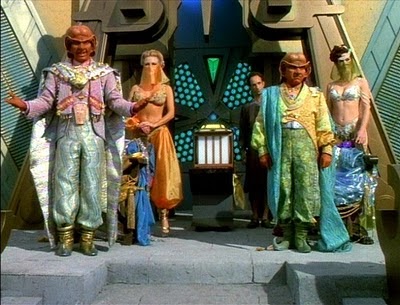
Greed at its Extreme: Perhaps Jefferson's concern was captured best by the fictional Star Trek characters, the Ferengi, who are known for their enterprising savvy to the point that they are con-artists. In the Star Trek Voyager episode “False Profits”, Figure 1, the enterprising Ferengi posed as gods and established their Code of Ethics based on the Ferengi Rules of Acquisition, a Bible of sorts, that have principles of economic vanity. Are humans on Earth to become like the Ferengi on Takar?  Will the next tyranny be corporate demi-gods in a socialized economy after capitalism dies? 


On planet Earth, humans must come to terms with the purpose and meaning of their existence. Living by Rules of Acquisition or strong economic vanity, like the Ferengi, reduces life to an economic venture, mere pennies on the dollar.  Humans should reconsider the meaning of work as a component of their lives but not the defining doctrines in their life. Economic affluence, wealth, is not available to all humans. Most humans live a modest life and have other focuses in life.

Interestingly, Jefferson saw commerce as a source of good and a fabric of a capitalist society that lead to the sense of national happiness found in the Declaration of Independence. However, Jefferson stopped short of social justice and viewed merchants as having no loyalty to a country or moral system (Mayer, 1994, pp. 137-138).  America is at a juncture. The question is will America retain the capitalist views of the founding or become some sort of socialized economic center of influence? Will our gods become enterprising tycoons and their sense of ethics? Goerge Soros, a billionaire and philanthropist,  remarks that he saw no point in having a god until he became one.  Will your ethics, morals, and principles be determined by your paycheck? How much control over you will you give your employer?

Janis Joplin, for all her drug-induced shortcomings, prolifically sang in her song Me and Bobby McGee, "Freedom's just another word for nothing left to lose." 

References:

Federer, W. (1996). America's god and country: encyclopedia of quotations.  Fame Publishing: USA. 

Mayer, D. (1994). The constitutional thought of Thomas Jefferson. University Press of Virginia: USA. 

Menosky, J. & Brozak, G. (Writer) & Bole, C. (Director). (1996). Star trek voyager: false prophets season 3 episode 5. Paramount Television