Tuesday, May 12, 2015

Gasoline: Nemesis or Necessity

Foreword: Fuel economy has a lot of focus today with the higher cost of energy. There is a lot of information out there of which much of it is not accurate. I tried to get to the bottom of what is going on and understand the processes. If possible, I wanted to seek a way to improve the fuel or blend for real fuel economy. In this blog post I explore the science, blending, and politcs of gasoline. 

Gasoline: Nemesis or Necessity

Every gas tank is tracked for fuel economy as fuel economy can mean major improvements in cost. Over the years, I noted that the gas mileage was erratic. At times, the miles per gallon were very high and a short time later it would be the worse ever. Only to return to a very high value sometime later. There was little discernible pattern at first glance. I used the same gas station for years and only bought premium unleaded. The vehicle was in excellent running condition and the highest grade of oil filtration and oil was used in the engine. So for all intents and purposes there should have been some stability in the fuel economy but there was not. Something was going on but what?

I read innumerable articles and began to observe that there was circular reporting as well as severe group think on this topic of fuel economy. Everyone was copying everyone else to the point that they were recycling their own works yet citing other people who copied something of theirs. Every article read that engine knock was a outcome of low Research Octane Number (RON) or simply the fuel's Octane rating. Step up the Octane number and rid yourself of engine knock. Otherwise, there was no other purpose to Octanes. This did not sound accurate to me as purpose of Octane is not simply to rid engines of knock and pings which was actually a symptom of something else. Octane ratings are designed as a measure of fuel performance in order to optimize the application of thrust out of an engine. Engine knock is a symptom of poor fuel performance.

The Science and Engineering

The reciprocating engine involves usually four strokes; a draw stroke, compression stroke, power stroke, and expunge stroke. See Figure 1.  On the draw stroke air and fuel is drawn into the cylinder past the open valve. The compression moves upward increasing pressure on the fuel-air mixture. The spark plug ignites the fuel-air mixture and consumes all the oxygen. The nitrogen remains and expands driving the piston downward in a power stroke. The piston then travels upward as the valves open to expunge spent fuel, gases, and smoke.
Figure 1: The 4-Stroke Engine Cycle
The concept behind the Octane rating affects the power stroke. The Octane numbers relate to the rate of burn of the fuel. At higher Octane numbers the fuel burns more slowly applying constant pressure to the piston head for the entire power stroke as opposed to a sudden flash at the top of the stroke that could be at the incorrect time due to temperature and pressures in the cyclinder causing the knock sound. Ideally, the burn rate of the fuel should perfectly match the entire power stroke. This results in a smooth transfer of the fuel's undirected explosive energy into directed mechanical energy that moves the vehicle. Thus, the Octane rating is a measure of an efficient process in which the fuel is completely consumed over the power stroke. At lower Octane ratings a portion of the fuel is not spent. This residual fuel cokes (a hard black soot) the values, springs, and rocker arms in the head. Technically, at too high of an Octane rating the fuel-air mix could still be burning during the expunge stoke which is not good either. The design challenge is to match the power stroke travel to the burn rate of the fuel in order to optimize energy transfer and minimize waste. In doing so, the engine runs very smoothly. Thus, the octane rating for a vehicle is a fixed design feature of the engine. There is a little flexibility and with the age of the engine higher octanes improve performance.

Now that we understand the process and Octane rating efficiency of the fuel, we need to turn our attention to the fuel blending and composition.  Once again I was awestruck by the degree of misinformation in the articles I read. Numerous articles cycled on the internet discussing how to improve the grade or blend of gasoline using off-the-shelf products such as Methyl Ethyl Keytone, Benzene, Toluene, or Xylene. Wild claims were made that the Octane numbers could be boosted to over 100 at lower costs. Many articles claimed that up to 50% of gasoline was Xylene. Therefore, I looked up the chemical formulas for gasoline as well as other chemicals involved and the US standards for the various blends. 

First, let us look at the refining process. The older method is called fractional distillation. The crude oil is a mixture of several products, each having identifiable characteristics such a boiling points and weights. The crude oil is heated to the boiling point causing vapors to form which rise in distillation tower then settles based on their weight and Archimedes Law of Buoyancy. Collection plates are placed in the tower at specific locations that cause the vapors of a specific compound to condense on the plate before being drawn away for further processing. Methyl Ethyl Keytone, Benzene, Toluene, and Xylene are called feed stock commanding higher prices than if sold in the blend of gasoline. For example, Xylene costs about $18.00 per gallon. Gasoline is roughly $3.00 per gallon and has less than 1% Xylene.  Other chemical processing methods of separation exist such as cracking, unification, and alteration. The main point is that many compounds are removed and not included in the final fuel mixture due to component economic value.

In the end, the gasoline that results from the continuous manufacturing process is further treated to remove impurities, contamination, and water. Pure gasoline is a blend of hydrogen and carbon chains. Specifically, the chains from C7H16 through C11H24 are blended together to form gasoline. The combustion process for a Hydrogen-Carbon chain that is 2 parts C8H18 combined with 25 parts Oxygen results in 16 parts CO2 and 18 parts water, Figure 2. The 25O2 in this formulation is drawn in via the air intake on a carbuerated engine. 
Figure 2: The Chemical Formula for Combustion of Gasoline
As the fuel makes its way to the pump, additives are included such as upper cylinder lubricants, dyes, and ethanol.  Some of the additives improve the fuels performance and others such as ethanol degrade the fuels performance.  In brief, ethanol burns hotter and quicker than gasoline which degrades the fuels performance. At 10% ethanol the fuel efficiency is usually degraded by 4 miles per gallon. This is a good segway into the politics of fuel.  

Politics

The politics of energy covers a huge spectrum of issues mostly in the environmental realm. However, energy is also a huge revenue boon for nation-states through taxation. Essentially, the government through the mechanisms of taxation and process obfuscation take just rewards (consumer hard earn money) and redistribute them based on the whims of the aristocracy or the seat of power. This is also known as institutional theft or more commonly called social justice. A good example of process obfuscation is the formulation and blending of gasoline. Governments through their environmental agencies enforce blends of gasoline at different seasons and additives such as ethanol. Changing the formulation of the gasoline blend and ethanol mix can reduce the fuel economy resulting in more fuel to go the same distance. The taxes on gasoline are flat based on a gallon of gasoline. If traveling a fixed distance takes more fuel than before due to lower fuel economy then the tax revenue increases in relation to the fuel economy reduction. This can actually cause a reduction of disposable income if the reformulated fuel economy loss is greater than the lower prices. See Figure 3. 
Figure 3: Relationships Between Fuel Economy and Tax Revenues. 
If the fuel economy is 20 miles per gallon when pure and at 16 miles per gallon with 10% ethanol then the differential on a 15 gallon tank is 3.75 gallons more to go the same distance when using 10% ethanol. That is a considerable increase in cost to the consumer and a huge increase in tax revenues for the government.  For the consumer, there is little that can be done to improve the fuel efficiency that is also cost effective from the pump. Setting up a mini-fractional distillation plant to remove the ethanol does not justify the cost as at 10% there is 1 gallon out of 10 gallons that is ethanol. The consumer still pays for the ethanol. Simply purchase fuel without ethanol added.

Returning to the original issue of erratic fuel efficiency, the issue is mostly political as the government seeks to optimize tax revenues by managing fuel economy. The erratic fuel economy is due to seasonal fuel adjustments and the political climate seated at the time. 

Achieving Lower Fuel Costs

Of course, electing public officials who do the right thing is ideal. However, the current political climate in which corruption can be obfuscated in complex or layered processes is too tempting for self-serving public servants. Demanding transparency is an option but even that is difficult to achieve as the seated power base simply stalls and debates the issue rather than takes action. Consumers are relegated to purchasing more fuel efficient vehicles and seeking alternative fuels or transportation solutions in order to save costs. A time may be coming when single passenger vehicles for the work commute become more popular. One example is the ELIO. 


Monday, March 23, 2015

EDI Overview

Commentary: This post was originally posted 10Mar2011. I have made a few updates then published the post again. EDI is in pervasive use in manufacturing, logistics, banking, and general day-to-day website purchases. Many people have little understanding about EDI. I want to highlight what it is, general implementations, challenges, and benefits.

EDI Overview

Electronic Data Interchange, EDI, is the pervasive method of conducting business transactions electronically. It is not technology dependent nor driven by technology implementations. Instead, EDI is driven by business needs and is a standard means for communicating business transactions. The process centers on the notion of a document. This document contains a host of information relating to purchase order, logistics, financial, design, and/or Personal Protected Information (PPI). These informational documents are exchanged between business partners and/or customers conducting business transactions. Traditional methodologies used paper which has a lot of latency in that system and is error prone. Replacing the paper based system and call center systems with electronic systems do not change the processes at all since the standard processes remain independent of the implementation or medium. When the processes are conducted via electronic media the latency is compressed out of the system and errors are reduced making the electronic processing far more desirable given the critical need for speed and accuracy in external processes.

Implementing EDI is a strategy-to-task effort that must be managed well due to some of the complexities of the implementation. A seven step phased process highlights an EDI implementation.

Step 1 - Conduct a strategic review of the business.
Step 2 - Study the internal and external business processes.
Step 3 - Design an EDI solution that supports the strategic structure and serves the business needs
Step 4 - Establish a pilot project with selected business partners.
Step 5 – Flex and test the system
Step 6 - Implement the designed solution across the company
Step 7 - Deploy the EDI system to all business partners

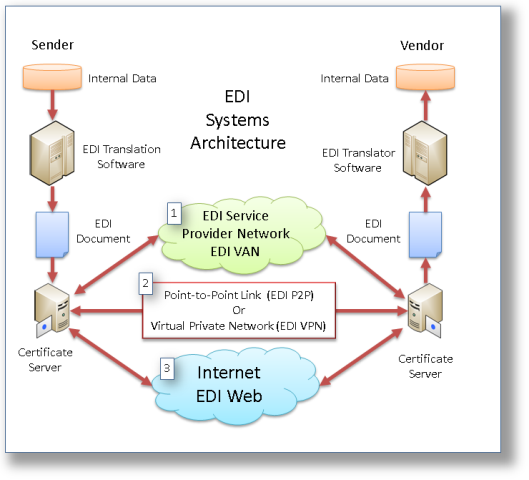
The technology used in EDI varies based on the business strategies, Figure 1. In general, EDI services can operate through three general methods; 1) the Value Added Network (VAN), 2) Virtual Private Network (VPN), 2) by Point-to-Point (P2P), or 30 Web EDI. The first two are for small to medium sized EDI installations where a direct association is known, established, and more secure. Web EDI is conducted through a web browser over the World Wide Web and the simplest form of EDI for vary broad based and low value purchases. The technology in use varies slightly and comes down to three forms of secure communications at a central gateway service such as Secure File Transfer Protocol (FTPS), Hypertext Transport Protocol Secure (HTTPS), or AS2 Protocol which is used almost exclusively by Walmart. Web EDI requires no specialized software to be installed and works across International boundaries well. Web EDI is a hub-and-spoke approach and messages to multiple EDI systems through its gateway service. In addition, industry security organizations provide standards and oversight for data in motion and at rest. PCI Data Security Standards is one such organization.

Figure 1: EDI Systems Architecture
Overall, EDI can reduce latency in business transactions and tightly adhere to the organizational strategies without significant adaptation of the organization. Organizations may try to outsource the people, processes, and even the technology as part of their strategy and objectives but processes remain consistent. In conclusion, EDI is a standard that is applied in various forms offering numerous advantages to an organization and business transactions.

Saturday, February 28, 2015

Supply Chain: Managing Butterflies, Not BullWhip

A butterfly fluttering in Japan causes atmospheric perturbations that can result in a hurricane in Florida. Hence, the Butterfly Effect states that small changes in a system may compound into large differences at a later time and different station in the same system.   The concept was originally introduced circa 1962 by an American meteorologist Edward Norton Lorenz, the Father of Chaos Theory.  Science rediscovered Lorenz's work in the mid-1970's and engineers began to employ its use in the early 1980s.  Business did not begin to consider the merits of Chaos Theory until the late 1990's when adaptability began to be of interest to organizations with rapidly emergent conditions.  As supply chain complexity increased then chaos principles began to apply to the chain. 

The Bullwhip effect is a result of a lack of visibility or transparency in the supply chain when estimating demand. Actors in the supply chain successively farthest from the end demand, compound errant demand estimates upon errant demand estimates. This creates excess supply that cost money, increase waste, and reduce profits. The problem successively increases from the end demand.  The BullWhip effect is a single problem in the supply chain. Albeit, a significant problem. Thus, the high degree of focus.  Butterflies, on the other hand, seem minor and can emerge anywhere in the chain creating upstream and downstream problems from where ever the disturbance appears. 

Supply Chain Project Failures, Successes, and Case Studies

Motorola was experiencing high scrap rates on an ultra-high vacuum semi-conductor process overseas causing supply chain disruptions that demanded an improvement. A project to find a solution revealed in lab tests an alternative process resolved the problem. The new solution was approved for a switch but failed in real-world applications causing offshore plant shutdowns and failures to meet normal demand.  The lesson learned for Supply Chain managers when dealing with projects that affect key processes is to start small and phase-in.  Motorola issued a policy that regardless of lab results, critical manufacturing process transitions begin with less than 10% of the production line followed by review and analysis. Once approved then a scheduled increase begins over a minimum of four months (Hoffman, 2003). Project managers are accustomed to phases, milestones, and reviews. Supply chains are no different. 

Shea Homes wanted to build more homes in less time without spending more money. The challenge was a resource restraint. A self-imposed requirement to do more with less or improve efficiencies. There were more than 54 subcontractors in the supply chain operating on multiple sites and multiple jobs. Often tasks were done out of sequence as subcontractors worked at a job site until there was a problem or roadblock then moved to another job site. The hopscotch approach wasted time, money, and was riddled with delays. The project manager established a critical chain that eliminated the multi-tasking replacing that with a continuous workflow and synchronous schedule. The critical chain was a cultural shift that required training. After implementation, Shea Homes observed a 42% reduction in time to build while increasing their return on investment.  The change also resulted in guaranteed move-in dates, competitive advantage, and a marketing tool. The the critical chain strategy focused all efforts on the critical path to completion (Hunsberger, 2012). Project managers are very familiar with the critical path.  Thus, supply chains should be organized around a critical path and such that all decision making is focused on the integrity of the critical path. 

Redtag, Inc was faced with high supply chain costs with an objective to reduce costs by a minimum of 10%. The supply chain stretched from Asia to supermarkets across the United States. Deliveries were driven by events and holidays often with short lead times. In order to avoid delays, shipping and freight costs absorbed the short lead times. The solution was to form a strategic alliance with an inland freight distributor. Imports were taken as far as possible over water before arranging ground transportation. The lower inland freight miles traveled resulted in more than 30% reduction costs (Markarian, 2003).  Strategic Alliances may improve the bottom line costs but they also place new constraints on the company. Project managers must understand the supply chain strategy such that, in this case, while the goods are on the water they are slow and cannot easily change modes. Other projects may be impacted by these kinds of strategic constraints that cannot be easily changed. 

Legal troubles are common in supply chain disruptions and a supply chain project manager has a duty to mitigate legal troubles. Proactive reviews of contracts and procedures are essential (Markarian, 2003). 

Establishing a Project Ready Supply Chain Culture

Supply Chains are dynamic enterprises in constant flux. A single organization may have a considerable number of supply chains and projects that may affect one or more of the chains. Projects and change can arise anywhere in the supply chain affecting quality, cost, schedules, and scope within the entire chain.  There has to be a common operating environment for projects to occur within. We saw policies being written at Motorola to mitigate issues and critical path being established in order to create efficiencies among the subcontractors at Shea Homes. RedTag sought a strategic alliance.  These strategies, policies, and processes need to be communicated. Anytime someone in the chain has changes or projects these have to be vetted against the strategies, policies, and processes in use up and down the supply chain.  Finding who in the chain will manage this can be difficult. Some people think its the project manager's duty but that can be a problem as project managers do not always have operations management backgrounds.

Often the dominant supply chain actor manages the chain by fiat but this is not always good for the supply chain. The dominant actor may be remiss or selfish in managing the chain.  On occasion, the supply chain is managed by an external actor such as an appointed fiduciary, working group, or by a council. This happens when there are legal issues surrounding procurement and/or unbalanced competitive actors influencing outcomes. In many, supply chains there is an absence of overarching management. Project managers operating at any station in the supply chain may find themselves in a vacuum of management and with multiple projects that could impact the entire supply chain. If in the dominant role then establishing management of the supply chain projects is easier but that is not always the case nor good. In short, a supply chain project manager must wear other hats to include an OM hat.  The best project manager can do is manage from their station if unable to rally support for overarching management and project managers should use the project plan. 

Project Management hovers around the project plan, Figure 1, which has numerous subset plans such as change management, communications, and quality plans. Sometimes these subset plans are just a paragraph in the larger project plan or may not even appear depending on the project. Nonetheless, the project plan is the primary artifact in any project. 

Figure 1: The Project Management Documents

Plans are limited because they are focused and narrow in scope. In the case of a project plan, the subset plans are unique to the project and can be different for each project even though common elements exist is a supply chain. As projects come and go, sometimes with a high degree of frequency, tracking policies can become confusing. Additionally, supply chains are coalitions of many players. Some are dominant and wield control over the supply chain. Other players are minor contributors and a single supply chain can become costly for them with little influence. Standards need to be set with stable expectations for performance for all players. Plans are too short-lived and can vary by the different leaders. The solution to this challenge is the establishment of programmed management or management programs. 

Management programs in the Operations Management, OM, the view is different than Program Management in the Project Management Institute's, PMI's, view.  PMI considers program management to be a project-of-projects or simply the Mega Project architecture. Operations Management considers a management program to be a loosely written document for specific management of an activity detailing the principles, processes, responsibilities, authority, and decision-making guidelines. The concept of loosely written refers to the degree of cohesiveness in the document. Strict cohesiveness binds activity from operating outside the policies and rules using terms like shall, must, and sets discrete limits. A loosely cohesive program is flexible and allows room to operate using terms like may, should, and sets ranges vice limits. The degree of cohesiveness is a combination of strict and loose. Management programs are useful in highly complex operations involving rapid change, regular turnover of personnel, quality and safety concerns, as well as financial impacts among other issues. These program documents are the baseline management policies, provide stability, and available to everyone.

Mapping typical project management plans to the supply chain in order to organize management programs, Figure 2, should use the APICs supply chain model.  These project management plan elements are expanded and become written management programs for the supply chain. 

Figure 2:  Mapping Project Management to Manufacturing Supply Chains


When developing a management program, a supply chain working group should be formed in order to obtain buy off from everyone upstream and downstream. The program should detail policies and responsibilities for not only the dominant actor in the chain but more so for others whose projects may affect the entire supply chain. The programs should detail processes for vetting impacts, communicating, and processes as well as timelines before acting. There should be an annual review of each program and a process for interim changes. Once agreed upon the program should be published for all actors in the supply chain.

When a project develops, the elemental pieces of the project plan are already established and known. The project should incorporate these standing policies and practices with authorities and responsibilities already understood. The program management concept was established in the post Project Complexity Perplexes Procurements in order to gain control over complex procurement processes during large scale projects.

In conclusion, establishing the policies, procedures, authorities, and responsibilities as a stable program up and down the supply chain helps avoid the injection of unanticipated changes during projects. For example, a material quality change that reduces cost for one actor with the intention of improving supply chain performance may reduce quality for another down stream causing increases in warranty issues.  Having a supply chain quality program in place helps project managers identify and vet quality change impacts to the supply chain during process improvement projects. 

References:

(2011). APICS Certified Supply Chain Professional Learning System. (2011 ed.). Version 2.2.

Hoffman, W. (2003).  Missing links. PM Network. Resourced from http://www.pmi.org on June 5, 2014. 

Hunsberger, K. (2012). Chain reactions. PM Network. Resourced from http://www.pmi.org on June 5, 2014.

Markarian, M. (2003). Tightening the supply chain. PM Network. Resourced from http://www.pmi.org on June 5, 2014.

Originally posted on January 15, 2014.

Tuesday, December 30, 2014

Transitioning World - New Economy?


Foreword: This post was originally posted in December 2010 titled "Reflecting on the Character of Business and the Economy". I have updated this post to reflect the current circumstances as of April 2012, April 2013, June 2014, then again December 2014. The last update increased support for the view expressed. This post is lengthy but necessary to communicate the view with robust support.

This an open discussion that looks at interesting and traditional thinking given the change imposed on the world. This is intended to be thought-provoking by presenting views that often are overlooked or missed in the demagoguery. Whether there is merit and if what has been presented is good or not is for you to determine. 

The Economics

During November 2014, economist Steb Hipple, Ph.D. of the Bureau of Business and Economic Research made a presentation regarding the U.S. economy at a professional dinner. Two of the key slides from the presentation are provided. Figure 1 is the Real GDP Growth from 2007 to 2014.  The 3% dotted line is normal and stable economic growth. If the area above this 3% line is computed as a positive and the area below the 3% line is computed as a negative then added together the result is a significant net loss during this time period. In short, there has been no economic recovery since 2007.

Figure 1: Real GDP Growth


Figure 2: Long Run U.S. Employment

Figure 2 is the Long Run U.S. Employment graphic between 2002 and 2014. The Full Employment Level curve illustrates normal employment had the economic recovery occurred. The Official Employment Level curve is the U.S. Government's report regarding employment levels between 2002 and 2014. In short, there has been a net loss of jobs beginning in 2008 which is the space between Full Employment and Official Employment. In an eyeball of Figure 2,  at 2010 the gap is roughly 10,000,000 jobs lost that persist in the US without any substantial closure between the two curves.

Overall, there is a net loss of GDP and a net loss of employment without a net reduction in the employable population. Where did the GDP and jobs go? Some of the GDP was lost due to reduced demand and a greater portion was transitioned offshored. Likewise, most of the jobs were offshored, some jobs were eliminated due to increases in efficiencies, and some were lost due to lower demand.
Figure 3: Economic Super Cycle or Kondratiev Wave

Figure 3, there is an economic cycle characteristic of capital economies that has a period of about 80 years having transition points that are characterized by a brief time during which there is a short economic boom then a bust followed by war and finally a new way of living.  The concept is called a supercycle also known as the Kondratiev Wave. The durations in Figure 3 are approximations as the cycle has some variance. During the sustainment period, technologies and concepts emerge and in their infancy gain support and enthusiasm leading into the boom period.  The short boom period begins a regeneration of the economy.  Following a short boom is a bust period during which unemployment is high and inflation sets in causing a depression-era or a severe recession. War follows the bust resulting in rationing, a reduction in populations, and a loss of economic capacity and/or capabilities. All of the losses must be restored to the new sustainment levels in a new economy centered on the technologies and concepts that emerged prior to the brief boom period.

The Super Cycle seems to coincide with significant U.S. history. Specifically, the Revolutionary period, the Civil War period, the World War II period, and the current economic period. All of these periods were characterized by a boom, bust, war, then a new way of living. For example, The Roaring 20's led into the Great Depression and World War II with the new way of living centering on personal appliances and transportation which was the age of luxury living. Today, the housing and Dotcom boom has led to the current down economy which has now persisted for over 7 years. If on point, then the cycle should have a war in the next 2 to 5 years. Most futurists speculated during the 1990s that the new economy would be based on social, communications, informational, and logistical networks.

Overall, the evidence is pointing in a direction that the world is amidst a major transition and the future is not entirely a gamble. There are patterns and trends that can be leveraged smartly and are more apparent than not. The question is will the economy be a capital economy or a command economy?

The Transitioning World

The world has made transitions from a theological pride to a secular nationalistic pride for over the course of 2000 years. History records the transition for Israel to secular governance during the time of David. Other transitions are occurring right up to modern times. For example, a 1950's mass movement demanded national self-determination for the Bengali people. The politician-preacher Maulana Abdul Hamid Khan Bhashani championed the demand for national self-determination and the demand that the state distance itself from Islam. Bhashani led the transition to secular politics in the decades that preceded the emergence of Bangladesh.

Today, the world is in transitioning once more. This time towards an economic pride as evidenced by regionalization efforts ongoing throughout the world such as the European Union, EU, and others in Africa (ECOWAS), South America (UNASUR), and the Western Pacific (APEC). Keeping in step, the region currently known as North America is undergoing several major transitions. The first major transition is a movement away from national sovereignty towards a regional center of economic influence under the auspices of the North American Free Trade Agreement, NAFTA. The second major transition is the form of governance that will be over newly formed NAFTA region. Some form of governance needs to emerge since all the participating national identities are consumed in the larger organization and newer identity. Will that be a Islamic Caliphate, a Progressive ideology, or will a constitutional form of Government prevail.  The final major transition is the character of the economy within the NAFTA region. In this discussion, the focus is a little on the regionalization effort and more on the character of the economy as well as on the character of business.

The movement towards a regional center of economic influence is evidenced by the NAFTA treaty coupled with the rapid infusion of foreign nationals effectively dissolving the international borders between the participating nations; Canada, The United States, and Mexico. NAFTA, as a treaty, originated from the Montreal Economic Treaty during the Reagan years. The objective was to reduce the wage differential between the US and Mexico in order to reduce illegals coming across the border for work. In 1992, U.S. political leadership converted NAFTA to a new political system in order to advance a regional center of economic influence. Henry Kissinger commented on the passage of NAFTA during 1992, as a regionalization effort, that “...is not a conventional trade agreement, but the architecture of a new international system [of goverment]" (Henry Kissinger Los Angeles Times, 1993).

Since 1992, the political leadership has been expediting the regionalization as anxious ideologues leap at the opportunity to advance their ideology that may have the effect of superseding the US Constitution. The construction of NAFTA superhighway, Figure 4, if not intended, has the effect of increasing the freedom of movement throughout the region for Mexican and Canadian nationals. While the original effort to build a new superhighway was effectively stopped, a new effort has now been adopted expanding the existing highway infrastructure for the same purpose. Fannie Mae and Freddie Mac, if not intended, has had the effect to quickly stabilize immigrants in homes. Likewise, the ability to vote, obtain a driver's license and healthcare are instruments that, if not intended, have the effect to stabilize immigrants more quickly than the traditional course of three generations. The passage of nationalized healthcare on March 21, 2010, brought the region closer to a regional healthcare system as Canada and Mexico are already on socialized healthcare. 
Figure 4: NAFTA Superhighway Map.  Source: NASCO
The regionalization phenomenon extends beyond geopolitical systems to other systems. For example, power companies have been consolidating and regionalizing power systems. The same has occurred with the phone companies, and now health care is consolidating under the nationalized healthcare system. We observe companies like Duke-Progressive Power consolidating control of the American SouthEast power distribution.  Kaiser-Permanente has consolidated healthcare control of the American West. The phone companies have gained regional control such as Bell South. Even the grocery industry is regionalizing with Von's in the SouthWestern US and Publix in the SouthEastern US.  These regionalized centers of supply point control cross state lines. Thus, state's rights are challenged as power shifts to interstate trade and control by the federal government. This regionalization of supply points will continue to increase and dissolve state sovereignty.

Whether this regionalization is deliberate or natural course of a systematic pattern, the advancement of an economic center of influence and dissolve national and state sovereignty is emerging as an inevitable future for the North American region. Such regionalization has tremendous impacts on industry, commerce, and individual lives.

The Free Market Capitalism and Business

As regionalization expands, the character of the economy in the emerging regional center of economic influence is an underpinning of the governmental form. Socialized and Marxist governance is reliant upon the notion of social justice or the use of governmental methods to redistribute wealth to those deemed less fortunate by the aristocracy in a command economy. The social justice operative mechanism of redistribution is analogous to institutional theft which is considered to be the worst form of theft since people are denied just fruits of their labor. A competitive model is Ayn Rand's worldview detailed in her works "Atlas Shrugged". This model is a separation between economics and government similar to the separation of Church and State. Rand's model is ultimately a Godless society focused on economic pride or gain. The character of the economy in a Democracy is free market capitalism which places human creativity in service of humanity.

In the free market economy industry and business redistribute wealth based on value-added or created value. The free market is considered natural because when freed of all regulations and other constraints such as taxation the free market character persists. While this discussion uses the term free market most societies impose some degree of controls and constraints on the market. Thus, a free market, in practical terms, is considered one with minimal controls and constraints. The free markets existed long before modern complex economies emerged out of feudal Europe. Unregulated markets operated over 2000 years ago throughout the Middle East, Greek, and Roman Empires.  The largest Roman seaport and marketplace located in Pozzuoli, Italy called the Serapeum, Image 1. (note: The term Serapeum is  actually a religious temple. The Italian Government officially recognizes the site as such. Scholars and the locals acknowledge the site as an ancient marketplace.)
Image 1:  The Serapeum Ruins, Pozzuoli, Italy. The photo was taken by JT Bogden, February 2008
The efficiencies in a free market are also considered to be natural as opposed to human-induced efficiency efforts when inefficiency is perceived by the aristocracy and/or government in a command economy. For example, anti-trust lawsuits and regulations have often been touted as supportive of competition and the free market. However, the application of anti-trust lawsuits has typically emerged out of power struggles between Governmental enforcement of regulations and industry compliance.

During the 1970s the U.S. Congress was instituting many environmental and labor laws that dramatically affected industry. Industry reacted sternly using economic influences to apply pressure to Governmental leadership in efforts to change the direction of the legislation. Governmental leadership fearing industry had become too powerful sought to marginalize the influence by breaking up large corporations using anti-trust lawsuits. Some analysts tout that the computer revolution was actually delayed until 1985 because of anti-trust lawsuits during the 1970s. Henry Novell of Novell Systems was employed at Bell labs when the anti-trust lawsuits stopped AT&T from entering the computer networking market during the 1970s and forced the breakup of Bell Systems forming Lucent in place of Bell Labs. Novell left and formed Novell Systems networking computers about 7 years later. "Antitrust policy over the last 25 years can claim substantial achievements. First, the stated terms of the debate have shifted to consumer welfare and efficiency, and away from vague and easily misused goals such as dispersion of political and economic power," (Bittlingmayer 2002, p 52).

Regardless, of the reasons or outcomes the point is that, in this case, governmental efforts at improving competitive efficiencies were tainted with political bias and may have never achieved the efficiencies sought. The efficiencies were observed later as an outcome of deregulation efforts during the 1980s in a return to more free markets. Such deregulation leads to competitive forces in the airline industry, telecommunications, and other industries.

One Business Model to Consider

Counter to popular thought, the free market model of business, Figure 5, is not one of a bottom line but instead one that is zero-sum in the long term for business. The bottom line, Profit = Revenue - Cost from the income statement and resulting business ratios, has its place metering efficiencies during the short term. Businesses are usually started and operated in order to support a lifestyle for the owner and their family based on the value created in the business. In the end, the business is sold putting cash in the pockets of humans upon sale or liquidation. Thus again, the business is a vehicle to put purchasing power into the pockets of people in order to give levity to their lives. The business is zero-sum in the long term and redistributes wealth based on created value. That being said, free-market business is actually all about the well being of people and is based on their productivity or ability to do good.
Figure 5: Free Market Business Model 
It's Really All About the People

There is an old adage that circulated on the state of our lives remarking that at least we got jobs and can put bread on the table. When we made more we were willing on our own accord to be charitable, to give from the heart. In a Democracy and free market, individuals are compelled through a social conscience as opposed to a social justice to be charitable with excess. Charity is usually driven by one's worldview. However, America has been struggling with its identity as the forces of multiculturalism are reflected in society and government.

I want to reflect on the classic movie, "It's a Wonderful Life". Jimmy Stewart had a social conscience helping people not only get by but also achieve their dreams. In time, that same charity flowed back to Jimmy Stewart after, through misfortune, his bank came up short on its receipts. In the recent biographical story of James Braddock, "Cinderella Man", Braddock sought to put bread and butter on the table during the 1930s remarking that he returned to boxing, his job, to fight for his family endearing the hearts of millions. In both these instances, it was a social conscience and productive work that overcame adversity in people's lives.

Wrap Up

Current economic cycles are pointing towards a new economy and a new way of living. These economic cycles coupled with political reforms and supply point consolidation are reshaping current political systems into regional centers of economic influence. As the new regional economy develops concerns arise regarding the type of economy and governance. As competitive ideologies battle for dominance, the casualties are human livelihoods and the quality of life.

Competitive systems such as progressivism better known as socialism or communism in the worst form marginalize human creativity and deny humans just compensation though the operative mechanisms of egalitarianism, welfarism, and social justice which amount to nothing more than institutional theft.

The strongest socio-economic and political system is democracy and free-market capitalism due to the support for giving levity and dignity to individuals. Wealth is redistributed based on productive work as individuals receive just compensation for their efforts. Free market mechanisms such as innovation, creative destruction, and creativity in service to humanity improve the quality of human life. Choices will need to be made and leadership selected who will uphold the dignity and levity of life for everyone.

References:

Bittlingmayer, G. (2002). The antitrust emperor’s clothes.Resourced from http://www.cato.org/pubs/regulation/regv25n3/v25n3-11.pdf

Hipple, S. (2014). Business Conditions and Outlook. East Tennessee State University.

Palmer, T. G. (2011). The Morality of Capitalism: Introduction. United States of America: Jameson Books, Inc.

Sunday, December 28, 2014

Protecting Your Idea?

Foreword:  Over the years I have generated numerous ideas, researched technologies and markets, and developed business plans. Some very viable and others not so viable. These matured ideas have been closely held as I watch for potential opportunities and fits. I don't see a need for a rush to market as there rarely is ever a need to rush. No perceived competitors are developing my ideas. I compete against myself unless I let out my ideas for other to develop. Nonetheless, I learned a few things along the way and would like to share them at this time.

Protecting Your Idea

‘Necessity is the mother of invention’ is an age old axiom that utterly gets it wrong because people rarely think of the invention necessary to fulfill some need. This does happen for example with the squeezable ketchup bottle which is not really an invention since the ketchup bottle and pliable materials already existed but not in combination. Instead, the squeezable bottle was an improvement, an innovation, as pliable materials were applied to a need to dispense ketchup. Inventions are something entirely new and create markets where nothing existed before. For example, the invention of the light bulb created new markets altogether. No one was asking for a light bulb as it was not in the minds of people. The light bulb was a phenomenon known as creative destruction where the new creation replaced the older creation, oil lanterns. The light bulb was also in service to humanity because it was safer than an oil lantern and was smokeless increasing possible placement options. More accurately ‘Invention is the mother of necessity’. Once introduced to the light bulb, people needed the product leading to markets for lighted signs, traffic signals, stylish lamps, ect... (Schwartz, 2004, p 13).  Ideas mature into inventions and/or innovations.

Everyone has ideas which are a dime-a-dozen. In many respects, ideas are like opinions which are unsupported beliefs that people hold with a high degree of confidence and esteem.  After all, they thought of the idea. An idea has no redeemable or measurable value in practice which is called utility. Therefore, an idea has nothing to protect, no utility. Utility is coupled closely with design having three elements; behavioral, sensation, and reflective. Utility in these three elements varies. Behavioral utility refers to the effectiveness of the design or the ability to perform work and is most often tangible. Sensation utility is artful invoking the senses or some sort of sensory experience. ie it is pleasing to the eye. Reflective utility centers on the story or message communicated.

When an idea is developed into a mature concept then that can be protected. A mature concept involves developing the idea into something that has economic value and is unique due to one's work, knowledge, and skills. A mature concept is said to have utility. At this point, the idea then becomes what is known as intellectual property. The challenge then becomes how does one introduce intellectual property in a public forum to a tightly held small group or to a larger constituency without losing control of the rights to the intellectual property? There are a few practical things that one can do which will be discussed.

First, realize that any business engagement should be shrouded in a legal blanket at some level based on the assessed risk. Of course, hiring an intellectual property attorney with all the associated cost and protection to oversee the entire process is ideal but not practical for the person who has limited resources while pursuing opportunity under the American dream. Each person should assess risk early and continuously. There is a process to developing then leveraging intellectual property for profit which begins with answering several questions.
  1. Does your product or service offer exceptional utility at an attractive price?
  2. Can product or service be delivered profitably within the organizational framework?
  3. Does the innovation/invention cause a disruptive shift?
The three questions center on the designs ability to not only produce revenue but do this in an attractive manner yielding low cost and new markets leading to profits. This is where the design must focus. Selling the design to prospects is more about mobilizing minds or convincing prospects to buy verses rejecting the design or stealing the design concept. When the design is good but the price is unattractive minds tend to think of ways to perform the same result at a lower cost. Prospects are more inclined to buy if the price, design, and effort for them are all attractive. Achieving this balance is an art in itself that begins with a process that has several steps to become organized into order to present.

1.  Develop an engagement plan. Such a plan will document the objectives of the design and engagements as well as provide schedules, prospect qualities, identify controlled information, set milestones, etc… The plan will vary based on the design concept and circumstances but should wrap around the entire effort organizing thoughts. Remember though that technology will always drive the schedule. Setting milestone dates instead of milestone achievements could create an optic of being late when dates are missed because the technology was not cooperating.

2.  Organize a team. Do not go at this alone. Become surrounded disciplinary experts. These experts do not have to be full time employees nor costly professional services. Services like SCORE under the Small Business Administration and small business incubators or development centers are available to nearly every city. Leverage these resources. When meeting with prospects at a minimum let them know about key team members such as CPAs and Attorneys. Arriving at the table having had CPAs and attorneys even engineers behind you can give a polished optic.

3.  Do the due diligence and study prospects. Study the prospects closely and learn their capabilities, capacities, and strategies. Understand the industry and business. Couple everything to the prospect’s direction, strategies, and operations highlighting advantage and earnings. Likewise, if a prospect turns out to be not a good fit then do not pursue them. Have standard evaluation criteria and seek performance measurements.  

4.  Create a Buzz. After becoming established and setting the necessary legal protections. Leverage social media and other media channels to create a buzz about the design concept. Have the market back pressure suppliers for the concept. Look for reflected messages and chatter. This can be a greater selling point than any face-to-face presentation as market demand drives demand for the concept.

5.  Prepare preliminary documents and presentations. Carefully craft the presentation as there can be legal repercussions. Documents like prospectus, forecast, pro-forma financial statements, ect… can be misinterpreted if ambiguous or if there is perceived innuendo. In preparing the documents use a rating system to classify information by paragraph. Such a rating system should include public, private, and closely held information. Avoid using any jargon or language that could be confused with the federal government’s classification system.

6. Meet with prospects. Face-to-face meetings are extremely important. A well designed and rehearsed presentation that does not go too deep but tickles their hot buttons should not exceed 30 minutes. Public and private information should be released after there are proper legal controls in place. Avoid releasing anything closely held until more advanced meetings and stronger legal protections.

7.  Negotiate wisely. Negotiations are always a challenge. The current mantra in most negotiations is Win-Win and empowerment. Win-Win is about putting everything on the table then finding the winning solution for both parties. Search out high value/low cost concessions. Find options to expand the pie for mutual gain. Know the best alternatives to a negotiated agreement. Empowerment is allowing the other person to have optimal control of their circumstance. This is a key in negotiations as a person convinced against their will remains unconvinced. Do not yield to pressure but work amicably, exploring all options. All negotiations are performed in good faith based on common objectives.

8. Get a signed formal agreement then maintain the agreement. Getting prospects to sign an agreement, contract, an engagement letter, a non-compete, a non-disclosure etc… is a difficult challenge. There needs to be some sort of formal understanding that is drafted by competent legal services and signed by the parties before a major dispute arises. A common strategy or tactic of many professionals in business is to enter into a relationship and then find a problem to exploit in order to strengthen their position. These situations need to be locked down but not in a manner that incites a negative response from the prospect. Once signed, the agreement should be properly filed. Follow up is necessary to ensure that payments are being made in a timely manner with accurate amounts; are milestone being met, and is there any sort of assistance necessary. Showing involvement and interest opens up new opportunities.

Protecting intellectual property requires much more than just a legal document written and oversaw by an attorney. Protecting intellectual property centers on relationship management and requires a well thought out plan, presentations, and controls. The controls need to be properly timed as walking in with documents that need to be immediately signed is often met with hesitation. The relationship needs to be developed without releasing or distributing critical information. This often involves sitting in on meetings, discussing the business, and socializing one’s self before presenting any intellectual property. Each prospect is different and requires a keen eye. In the end, you will need to make judgment calls balancing risk and progress. The goal is to work in a manner where everyone succeeds and everyone is comfortable.

References:

Bryan, L., & Joyce, C. (2007). Mobilizing Minds: Creating Wealth from Talent in the 21st Century. USA: McGraw-Hill.

Christensen, C., & Raynor, M. (2003). The Innovator's Solution: Creating and Sustaining Successful Growth. USA: Harvard Business School Publishing Corporation.

Kim, C. W., & Mauborgne, R. (2001). Knowing a Winning Business Idea When You See One. Harvard Business Review on Innovation, 77-102.

Neumeyer, C. (2014). 10 Tips For Successful OutBound Technology Licensing. Retrieved from Avvo: http://www.avvo.com/legal-guides/ugc/ten-tips-for-successful-outbound-technology-licensing

Schwartz, E. I. (2004). Juice: The Creative Fuel that Drives World-Class Inventors. Boston: Harvard Business School Press.

Sullivan, P. H. (1998). Profiting from Intellectual Capital: Extracting value from innovation. USA: Wiley and Sons, Inc

Wednesday, December 24, 2014

The Generalist: A Valued Professional

Foreword: This is a contributing article to the Job Search Featured Posts. The dialectic struggle between the specialist and generalist has been raging for decades if not longer and a very misunderstood struggle too. During the 1980's being a specialist was taboo and limiting. As economies contract and jobs become more difficult to find, then the specialist increase in importance. Also head hunters will almost always seek specialist as they are easier to place in specific roles. The generalist is rarely ever fresh out of school but instead the specialist matures into generalist roles with experience and deliberate planned career tracks. Becoming a generalist is not by accident.

Organizations heavy on specialist suffer terrible fates after becoming too polarized and myopic. A balance between generalist and specialist is needed in most organizations. This post discusses the debate and outlines the value of generalist in the workplace. Then offers advice on how  companies can utilize the generalist.

Specialist Verses Generalist

The debate regarding Specialist verses Generalist ping-pongs around like Disney's flubber. Surveys of articles on the subject focus predominantly on earning potential and job availability for specialist and tend to ignore or dismiss the generalist altogether. Most of the articles and thinking were initiated by placement agencies in this debate having a heavy bias towards the specialist niche market and demonstrated a misunderstanding of the generalist professional.

The specialist is more common. They are journeyman in a trade, go to a vocational school, or train in a two or four year college on a specific skill set. Often specialists are certified by the industry, government, or vendors. Specialists are in trades like plumbers, electricians, carpenters, software programmers, customer service agents, realtors, insurance agents, engineers, accountants,  and many other careers of the like. The term tradecraft, craftsmen, and workmanship all describe the time earned skills or experiential training acquired to be a specialist. Specialists are in high demand as employment tends to be readily available and placement agencies can more easily place candidates who show longevity in the trade. However, specialists are also subject to supply-side economics. If there are too many in a particular field then the wage goes down and employment becomes difficult to find. The skill sets are also subject to obsolescence due to disruptive technologies and shifting economies. Economic forces of capital economies such as creative destruction drive change in which the specialist can become obsolete in time. For example, typewriter repairmen are hard to come by following the personal computing revolution. The specialist is task oriented.

The generalist is a different character altogether. Most generalist originate from the ranks of specialist as the generalist is often trained in a trade, possess certifications, and degrees. Most generalist possess advanced degrees. However, this alone does not define the generalist. Experience and character are greater defining qualities of the generalist. True generalists start out as specialist then begin acquiring a very broad base of experience across sectors, industries, and disciplines. Becoming a generalist shifts focus from a task orientation to big picture, broad processes, and strategies. The character of generalist begins to morph towards innovator, motivator, and visionary. The generalist can see the end state and step in where needed to move the process along. They may not be as concise or skilled as a specialist but the generalist can get the ball rolling turning over to a specialist if needed while maintaining the focus on cost, profit, goals, and objectives.

The challenges

Companies rarely realize the need for a mix of specialist and generalist viewing the generalist as taboo without fully understanding the generalist value. One challenge is that during austere financial times, companies focus more heavily on specialist as the focus shifts to sustaining current relationships and business. The thinking is improving time-to-market and quality in order to keep existing customers happy. The perception is that specialist have honed skill sets who get the task done quickly. Also the specialist becomes a filter mechanism or gauge for new hires based on longevity in the trade. 

Another challenge for generalist to overcome is the commoditization of skill sets usually through certification programs. Many professional organizations are producing certifications centering on a specific set of skills, a specialty, such as supply chain, project management, logistics, lean, TQM, Six Sigma, etc... Commoditization is not generally thought of as a good thing as it means earnings marginalize or wages go down. Many people complete school with degrees in psychology, history, or general studies and are unable to find work. They obtain a specialty certification in order to improve their employment prospects. Companies observe the specialty certifications then hire those specialists who subsequently promote into influential positions while maintaining the specialty focus. This exasperates the situation for the organization since the specialist has not rounded themselves out in ways that benefit the organization as would the generalist. 

The value of having generalist is the ability to maintain the broad scope organizational focus which gets lost when too many specialist are present. An indicator of having too many specialists is when the staff performs their duties without an acute awareness of the value of their contribution towards profitability and the goals of the organization. The possibility exists that well intentioned specialist have built an overtly and unnecessarily complex operation that serves some specialty but fails to serve the organizational objectives. This can be averted with a balance between generalist and specialist of which the balance is unique to each company.

Identifying The Right Generalist Type

Companies typically fall somewhere into the STaRS model. STaRS stands for Start up, Transitioning, Reorganizing, or Sustaining. Some organizations claim to be in all four modes simultaneously. If that is the case then the organization is in absolute disarray lacking quality leadership. Nonetheless, the mode of the organization will drive the talent required. Executive admins are most often trained to be generalists but the generalist should occur at lower levels in managerial and directorial roles as well. In many cases, generalist are found in analytical roles, advisory roles, or leading think tanks. However, not all generalist are the same. Each has a mix of experiences and training that form generalist focus areas and match up to the organizations mode. Three common generalist focus areas follow:
  • Entrepreneurial: This generalist is rounded in finance, operations, and information technologies plus well read and versed in emerging technologies, theories, and concepts. They have character traits that include charismatic leadership, insight, and vision and are enablers who put vision to practice. These generalist think in terms of the 80/20 rule and seek out the low hanging fruit to demonstrate quick results. Often these generalist are found leading work groups, tiger teams, or may be key stakeholders on a bootstrapped start up as well as companies in transition.
  • Innovator: This generalist is of an elite group that is highly skilled in a technical field. They spend a lot of time image streaming and conducting combinatory play in their minds visioning how things may play out. They network centers of knowledge looking for patterns and trends to exploit. They often are world-class innovators who mold and form our way of life by leveraging technology in ways that change our lifestyles. These generalist are often inventors and researchers. They may even be eccentric riding unicycles down hallways at work or wear red gorilla suits. The modes suited for this generalist are transitioning, reorganizing, and start up.
  • Business Minded: This generalist is similar to the entrepreneurial generalist but instead of creating new products, services, or businesses this generalist sustains an operation improving profitability and pulling the operation together like a well oiled machine. They may be analysts, project managers, operations managers, or other positions that transition, sustain, and reorganize the operations leaning out cost and increasing profitability.
Other generalist focus areas outside of business circles may involve the sciences, charity work, and social work. Nonetheless, the natural order is for specialists to carry out the generalists vision, goals, structures, and other bidings given the cross-functional nature of generalist.

Wrap Up

The generalist is not a career by mishap nor taboo. Instead, the generalist is a career progression most often emerging out of the specialist today. However, the traditional high school college preparatory curriculum and four college programs were originally designed to produce generalist with well rounded educational backgrounds. Economic, social, and political forces are remolding the traditional education more towards specialist training. This narrowing of  the mind is not consistent with the American Forefathers vision when Thomas Jefferson spoke about the "freest expansion of the human mind" (Federer, 1996, p. 324). Companies must realize the need for generalist skill sets in order to better design their operations in support of organizational objectives.

Selecting the right generalist type and properly utilizing the mix of generalist to specialist is an art in itself that seems to be missing in many companies as specialist promote into what should be a generalist position.  The generalist brings a highly valued skill set into the right levels within companies that can focus companies on organizational goals and profitability. Selecting the right kind of generalist is the challenge. In the past, succession plans and corporate recruiting was centered on finding and recruiting or promoting candidates who were generalist. But the mantra of change during transitioning times has wiped out many of these time tested and proven approaches.

Considering the current economic cycles having run now for over 7 years, the marketplace should be entering a general growth phase within the next 3 to 5 years. Recent drops in energy costs is a major underpinning of capital economies that have traditionally predicated expansion. However, confidence and private land ownership are other major factors contributing to growth but remain weak. Nonetheless, organizations should begin structuring for this coming cycle of growth of which the generalist can become an extremely valued asset. Placing structures for growth now can only benefit the companies in the current and in the future. When at the bottom, there is only one way to go - up.

References

Federer, W. J. (1996). America's god & country: encyclopedia of quotations. USA: FAME Publishing, Inc.

Tuesday, December 23, 2014

Flexibility In the New Economy


http://www.flexjobs.com/
Click to link
Comment: This posting was initiated based on the Flexjobs© query "Why is flexibility important to you?" After reviewing a few responses from others I saw that most people thought in terms of themselves viewing flexibility as a means to convenience. I wanted to respond in a way that was thought provoking and not too self-centered. After pondering the question a short while in search of a meaningful response, I crafted this answer.

Retrospective

During the 1990's numerous futurists were writing books predicated on the notion that there was a major transition coming. In developing their vision, those futurist back then looked to historical patterns then those authors speculated on all kinds of futures. One of the earlier books on this topic was Samuel Huntington's book "Clash of the Civilizations" in which the West faced off with the rest of the World. Other authors centered on adaptability and flexibility in twenty-four operations as well as leveraging chaos as strategy. Many authors saw a dispersion of workers from major cities into small towns and rural areas. Nonetheless, all these future visions had a few things in common.
  1. There was a major economic, political, and/or social renaissance on the event horizon that predicated the vision.
  2. A compression of time causing chaos or rapid change that was managed by adaptability and flexibility.
  3. A new economy that would be based on networks; social, information, communication, logistical, etc...
  4. There would be a turbulent transition period that some authors indicated would consist of a boom, bust, war, and a new way of living consistent with super cycles.
Decades now from Huntington's original vision, various elements of most of these visions seemed to have come into fruition. We find ourselves in a turbulent world of rapid change and what seems to be chaotic, hectic, frustrating, and even frightening at times. Many people observe a clash of world views in their workplace as political correctness has become deep set and ethics vary from person-to-person. On point, Flexjobs© posed the question, "Why is flexibility important to you?"

True Flexibility

True flexibility is not so much about being there to change your kid's diapers, spending time with one's spouse, or improving time utilization to get the honey-do list completed. Those activities are of convenience and somewhat important to many people. Flexibility in the real sense is about agility in the job market without disrupting the homestead. If we look back to the time period when the steel mills left, people stayed, and there were no jobs then we observe people living on governmental subsistence in blighted cities for over a decade as happened in Youngstown, OH. In order to turn those cities around, politicians and communities had to attract industry in the old way of thinking. They had to rezone then infuse cash in order to create new infrastructure in order attract business for those residents to find productive work. This was costly and took long periods of time.

Flexjobs leverages information technology as the futurist foresaw and virtualizes employment disruptions while compressing the duration of the disruption. Through the flexibility that services like Flexjobs offers, a professional can establish a homestead, raise a family, and enjoy their community without disruptions as in the past that required families to pick up and move to a new location where there are jobs or live a diminished lifestyle on subsistence or in a lesser job. Thus, today the disruption is now absorbed into the virtual realm. The jobs and the professionals meet up without geographic limitations. There are temporal constraints but the individual has the flexibility to absorb time constraints if willing to work off shifts and odd hours. Temporal constraints can also be overcome by piece work and reasonable delivery times offering expanded flexibility.

Combining flexibility with adaptability can lead to imaginative new entrepreneurial opportunities through a virtualized online architecture that embraces complex adaptive systems. While sounding fancy this is nothing more than a twist on outsourcing under which a company’s operation is composed of outsourced departments interconnected over the Internet. Interdisciplinary artisans come together virtually leveraging the various networks to form a business.

Answering the Question

Flexibility is much more than personal convenience to me. Flexibility truly is a key quality of a new economy that ultimately embraces democracy and capitalistic mechanisms of innovation, creative destruction, just compensation, and creativity in service of humanity. We see networks emerge out of a democratization of design. The old being replaced with the new as world class innovation leverages networks in service of humanity reducing lifestyle disruptions and opening new opportunities not previously possible.  These new opportunities are new jobs in the cloud and new entrepreneurial possibilities. Flexibility reverses the status quo in which work was a lifestyle to work that supports a lifestyle.

Bibliography:

Dent, H. (1998). The Roaring 2000's: : Building The Wealth And Lifestyle You Desire In The Greatest Boom In History. New York: Simon & Schuster.

Godin, G. (2002). Survival Is Not Enough: Zooming, Evolution, and the Future of Your Company. USA: Cahners Business Information, Inc.

Huntington, S. P. (1996). The Clash of Civilizations and the Remaking of World Order. New York: Touchstone .

Liotta, P. H. (2002). Chaos as Strategy. Parameters.

Palmer, T. G. (2011). The Morality of Capitalism: Introduction. United States of America: Jameson Books, Inc.


NOTE: Many other references are available on the topic of the future vision. These are some that quickly wrap up the view.

Saturday, July 12, 2014

Life's A Struggle, But You Can Win

I think everyone can relate to this essay about life's challenges. Most older folks agree that success is much more difficult today than 20 or 30 years ago. The workplace has become a drogue of political correctness, gossip, and crowd think driving people towards monochromatic thoughts, beliefs, and conduct. The ole axiom 'There no friends in a crowd' certainly holds true for the workplace as trust among coworkers plummets and people's expectation of success is often misplaced. 

This essay speaks to non-conformity and positions rebellion in a positive light. After all, the American Forefathers were rebels.  The essay's author, Erin Brockovich, queries, "Who is normal?" and applies the relativistic post-modernist dogmatic question, "Whose normal?" She goes on to discuss making your own success and finding confidence in yourself and abilities.  I think this is a lesson we all can take away from Brockovich's essay. 

Life's A Struggle, But You Can Win
by
Erin Brockovich and M. Eliot

Forget what others may say or think about you. I see my future as bright, even with everything that has happened to me, both good and bad, because I have proven all the "experts" wrong.  When I was a child suffering from undiagnosed dyslexia, everyone told me I'd be lucky if I graduated from12th grade. I recently came across a copy of the Lawrence Journal-World, my hometown newspaper, where one of the reporters interviewed several of my teachers and childhood friends and quoted them as saying that they never would have expected this kind of success from me. I thought to myself, "You see, Erin, this goes right to the heart of what you believe." 

The simple truth is, every person is unique, and success doesn't always mean uniformity, or conformity. Everyone's learning curve is different. The common factor among those who succeed is consistency, or the ability to utilize stick-to-itiveness. What is equally common is the fear factor among those who fail, who are afraid to see themselves for who and what they really are and accept it. For some who might be a little different, as I was, or a little rebellious, as I also was, it's even more difficult to go against the mainstream tide. Most won't or can't, and therefore they fail to develop their individuality, their talent, to celebrate what is unique about them. I call this the fear of individualism that is so pervasive in our society.

I was feeling a little sick the other day and stayed home, and while relaxing, I turned on a talk radio program. I can't believe what people are saying these days, how threatened they are by anyone who acts differently from others. "Why did he do this?" or "Why did she do that?" and no one is offering any solutions, which is not surprising to me.  If we seek advice on why we shouldn't express ourselves as individuals, what can anybody possibly say to bring us out?  This need to conform is killing the most creative minds. The solution?  Stop complaining or feeling sorry for yourself about what you don't have, and instead, ask yourself what you truly want!

Rebellion is not a bad word. It's a misunderstood word,  especially when it comes to young people. James Dean was a rebel. Amelia Earhart was a rebel. And so, by the way, was Thomas Edison. Ed Masry and my dad are two of the strongest rebels I've ever met. As far as I am concerned, rebel is probably one of the nicer things I've been called in the last ten years!

Too often we confuse the concepts of success and failure with normal and abnormal. Who among us is normal, anyway? According to whom? And who cares what they think anyway?

Is the janitor who lives down the street and who makes little money a failure because he doesn't make more money than his neighbor does? Some people have a narrower comfort zone than others. So what? As long as the janitor realizes it is less important to be the best janitor in the world than it is to be the best janitor he can be, he's not in any way what I would call a failure. And that's the whole point. As far as I was concerned, as long as I was being, or trying my hardest to be, the best Erin I could be, I could never be a failure, no matter what anybody else thought. 

The reality of life is that you deal with your circumstances as they come to you. You do the best you can, you try to stay in a positive mindset, and, as another woman I admire greatly who has also faced life alone once said, you hang in there because "Tomorrow's another day." When things get difficult, you don't turn tail and run. If you do, you can't like yourself very much, and that to me is the only real failure.

I remember a long time ago when I was working for a company selling a shampoo line named Lanza. It's the type of job in which a lot of rejection is a normal part of the day. One day a senior rep, who was evaluating me, watched me loose a sale. Afterwards, she took my pitch apart, almost word by word and said to me, "You know what, Erin, I am impressed by your ability to take criticism so well." "I don't see it as as criticism," I said, "just another way to look at myself."

And that's really exactly how I felt. Rather than thinking. "Ok, I just lost that sale, I must be a failure, I quit," instead  I'd stop and ask myself if maybe I did something to offend somebody. Why didn't I get that sale?  I'd want to know, so I'd ask the person who turned down the shampoo line to please help me help myself by telling me why. You'd be amazed how many people will take the time to explain the reasons for doing what they do and how often their actions have very little to do with you. 

That's why, if you've out of touch with yourself, you're never going to succeed, because all the negatives that you experience everyday you will carry on your own shoulders, as "your faults." Instead of doing that, you need to think things through. You must ask yourself, "What is it I am trying to achieve? Why do I want to achieve it? How can I go about it?"

I have never been afraid to be different, to let someone else say I'm a failure. That just does not matter to me. I cannot do anything I don't believe in, that goes against my code of ethics. Therefore, anything in my life I have done I've chosen to do. Oh sure there are times I have been frustrated, but I never let that stop me. I was frustrated not being able to finish school. Even though I could not learn the way other people did, I knew in my heart I had the ability to overcome my difficulties. In fact, when I tried again and stuck with it, eventually I was able to graduate from high school and go on to college, to get my associate's degree.

Do what you like and You'll Succeed.

What is the difference between talent and ability? Motivation. Better to try to be the best you can be than the best there is. Passion is the key to solving this equation. Skill without talent is never going to win out over ability infused with passion. No matter what anyone else may say, think, or do, let your passion guide you in life. When it comes to career and achievement, stick with what you like, and you will be amazed at how good you are at it. When I first began dealing with people as a salesperson, I discovered I had an ability to make them listen, and they often bought what I was selling. It was out of that first success that I realized I had an ability to communicate with people. ,  and whether I did well because I liked it or liked it because I did well, the bottom line was I liked it and I did well. This is the combination you are looking for in order to succeed in what-ever field of endeavor you choose to pursue. 

Be Realistic About Your Situation and Yourself.

Everyone can't be the leader of a team. We are all created differently, and while some of us have talents that are more obvious than others, we all have a level of attainment that we can reach. Remember, it is not the size of the dog in the fight, but the size of fight in the dog.

Ego is Our Greatest Stumbling Block.

When we think we can get away with something, it is because we think we are smarter or better than everyone else. We may be; we may not be. These are not deciding factors in any struggle. The willingness to try your best and fail will make your commitment that much stronger and your success that much more accessible.

Reference:

Brockovich, E. and Elliot, M. (2004). Masters of Success: Life's a struggle, but you can win. Eliot house Productions: Canada. pp. 19-22.