Saturday, July 12, 2014

Life's A Struggle, But You Can Win

I think everyone can relate to this essay about life's challenges. Most older folks agree that success is much more difficult today than 20 or 30 years ago. The workplace has become a drogue of political correctness, gossip, and crowd think driving people towards monochromatic thoughts, beliefs, and conduct. The ole axiom 'There no friends in a crowd' certainly holds true for the workplace as trust among coworkers plummets and people's expectation of success is often misplaced. 

This essay speaks to non-conformity and positions rebellion in a positive light. After all, the American Forefathers were rebels.  The essay's author, Erin Brockovich, queries, "Who is normal?" and applies the relativistic post-modernist dogmatic question, "Whose normal?" She goes on to discuss making your own success and finding confidence in yourself and abilities.  I think this is a lesson we all can take away from Brockovich's essay. 

Life's A Struggle, But You Can Win
by
Erin Brockovich and M. Eliot

Forget what others may say or think about you. I see my future as bright, even with everything that has happened to me, both good and bad, because I have proven all the "experts" wrong.  When I was a child suffering from undiagnosed dyslexia, everyone told me I'd be lucky if I graduated from12th grade. I recently came across a copy of the Lawrence Journal-World, my hometown newspaper, where one of the reporters interviewed several of my teachers and childhood friends and quoted them as saying that they never would have expected this kind of success from me. I thought to myself, "You see, Erin, this goes right to the heart of what you believe." 

The simple truth is, every person is unique, and success doesn't always mean uniformity, or conformity. Everyone's learning curve is different. The common factor among those who succeed is consistency, or the ability to utilize stick-to-itiveness. What is equally common is the fear factor among those who fail, who are afraid to see themselves for who and what they really are and accept it. For some who might be a little different, as I was, or a little rebellious, as I also was, it's even more difficult to go against the mainstream tide. Most won't or can't, and therefore they fail to develop their individuality, their talent, to celebrate what is unique about them. I call this the fear of individualism that is so pervasive in our society.

I was feeling a little sick the other day and stayed home, and while relaxing, I turned on a talk radio program. I can't believe what people are saying these days, how threatened they are by anyone who acts differently from others. "Why did he do this?" or "Why did she do that?" and no one is offering any solutions, which is not surprising to me.  If we seek advice on why we shouldn't express ourselves as individuals, what can anybody possibly say to bring us out?  This need to conform is killing the most creative minds. The solution?  Stop complaining or feeling sorry for yourself about what you don't have, and instead, ask yourself what you truly want!

Rebellion is not a bad word. It's a misunderstood word,  especially when it comes to young people. James Dean was a rebel. Amelia Earhart was a rebel. And so, by the way, was Thomas Edison. Ed Masry and my dad are two of the strongest rebels I've ever met. As far as I am concerned, rebel is probably one of the nicer things I've been called in the last ten years!

Too often we confuse the concepts of success and failure with normal and abnormal. Who among us is normal, anyway? According to whom? And who cares what they think anyway?

Is the janitor who lives down the street and who makes little money a failure because he doesn't make more money than his neighbor does? Some people have a narrower comfort zone than others. So what? As long as the janitor realizes it is less important to be the best janitor in the world than it is to be the best janitor he can be, he's not in any way what I would call a failure. And that's the whole point. As far as I was concerned, as long as I was being, or trying my hardest to be, the best Erin I could be, I could never be a failure, no matter what anybody else thought. 

The reality of life is that you deal with your circumstances as they come to you. You do the best you can, you try to stay in a positive mindset, and, as another woman I admire greatly who has also faced life alone once said, you hang in there because "Tomorrow's another day." When things get difficult, you don't turn tail and run. If you do, you can't like yourself very much, and that to me is the only real failure.

I remember a long time ago when I was working for a company selling a shampoo line named Lanza. It's the type of job in which a lot of rejection is a normal part of the day. One day a senior rep, who was evaluating me, watched me loose a sale. Afterwards, she took my pitch apart, almost word by word and said to me, "You know what, Erin, I am impressed by your ability to take criticism so well." "I don't see it as as criticism," I said, "just another way to look at myself."

And that's really exactly how I felt. Rather than thinking. "Ok, I just lost that sale, I must be a failure, I quit," instead  I'd stop and ask myself if maybe I did something to offend somebody. Why didn't I get that sale?  I'd want to know, so I'd ask the person who turned down the shampoo line to please help me help myself by telling me why. You'd be amazed how many people will take the time to explain the reasons for doing what they do and how often their actions have very little to do with you. 

That's why, if you've out of touch with yourself, you're never going to succeed, because all the negatives that you experience everyday you will carry on your own shoulders, as "your faults." Instead of doing that, you need to think things through. You must ask yourself, "What is it I am trying to achieve? Why do I want to achieve it? How can I go about it?"

I have never been afraid to be different, to let someone else say I'm a failure. That just does not matter to me. I cannot do anything I don't believe in, that goes against my code of ethics. Therefore, anything in my life I have done I've chosen to do. Oh sure there are times I have been frustrated, but I never let that stop me. I was frustrated not being able to finish school. Even though I could not learn the way other people did, I knew in my heart I had the ability to overcome my difficulties. In fact, when I tried again and stuck with it, eventually I was able to graduate from high school and go on to college, to get my associate's degree.

Do what you like and You'll Succeed.

What is the difference between talent and ability? Motivation. Better to try to be the best you can be than the best there is. Passion is the key to solving this equation. Skill without talent is never going to win out over ability infused with passion. No matter what anyone else may say, think, or do, let your passion guide you in life. When it comes to career and achievement, stick with what you like, and you will be amazed at how good you are at it. When I first began dealing with people as a salesperson, I discovered I had an ability to make them listen, and they often bought what I was selling. It was out of that first success that I realized I had an ability to communicate with people. ,  and whether I did well because I liked it or liked it because I did well, the bottom line was I liked it and I did well. This is the combination you are looking for in order to succeed in what-ever field of endeavor you choose to pursue. 

Be Realistic About Your Situation and Yourself.

Everyone can't be the leader of a team. We are all created differently, and while some of us have talents that are more obvious than others, we all have a level of attainment that we can reach. Remember, it is not the size of the dog in the fight, but the size of fight in the dog.

Ego is Our Greatest Stumbling Block.

When we think we can get away with something, it is because we think we are smarter or better than everyone else. We may be; we may not be. These are not deciding factors in any struggle. The willingness to try your best and fail will make your commitment that much stronger and your success that much more accessible.

Reference:

Brockovich, E. and Elliot, M. (2004). Masters of Success: Life's a struggle, but you can win. Eliot house Productions: Canada. pp. 19-22. 

Monday, June 30, 2014

Review: How to Find A Great Job in the Great Recession

This a review of the book, "How to Find A Great Job in the Great Recession" by Rob Wolf. I attended the Transitioning Professionals Thursday Meetings while in Tampa. Although, I did not attend the Job Search BootCamps. The program Rob offers is the first in a succession of programs. The second being the Team Up! by Orville Pierson. The third program is one on resumes and interviewing preparation. Although, Rob's program touches on this aspect and networking too.

Years prior to meeting Rob through an APICS career counselor, I had already performed much of the activities Rob touts in his book. I had developed with a CPA a financial vision that had been tracking well for many years up to 2009. Expenses were already streamlined and I was focused on the stated objectives of my plan. I knew what I wanted to do and already had a plan in place. However, following 2009 that effort went out the window with the down economy. I had actually prepared for the anticipated economic down turn but did not anticipate the savage economics of change politics that occurred simultaneously. During this time, I focused on completing some schooling, obtaining some certifications, and tried to find something reasonable that could utilize my skill sets. I was relegated to a situation in which I had to wait the environmental circumstances out. The program discusses bridging the gap on page 59-60.

Overall, Rob Wolf's work is salient and to the point. The book is a excellent guide for some one just coming into the job search situation or has been there with low results. I did find a few things that I did in my preparation that are missing in Rob's program and may strengthen Rob's program as well as also offering a new look at the book's organization. These will will be addressed in the review.

How to Find A Great Job in the Great Recession

Rob's program is a marketing program designed to prepare the job seeker for networking and the job search. The program has been running for over 9 years as has undergone several updates and revisions. The most recent revision is "How to Find A Great Job in the Great Recession: 12 Steps to A Job Recovery". The program addresses the 12 steps in 12 chapters as follows:
  1. Mission Statement
  2. Vision Statement
  3. Assessment and Values
  4. Financial Review
  5. Marketing Plan
  6. Networking
  7. Resumes
  8. Interviewing
  9. Recruiters
  10. Entrepreneurship
  11. Accountability and Building a Strong Calendar
  12. Ageism
This program is a method that works well. A stronger focus may require some reorganization of the process and grouping of the topical areas into functional topics. This is not to take away from the program but perhaps strengthen the program into functional categories. These are in no favored order. 
  1. Baseline Assessment; ( Financial Review, Assessments and Values )
  2. Survival Plan (Entrepreneurship, Bridging the gaps, Streamlining)
  3. Strategic Plan (Vision, Mission, and Objectives)
  4. Marketing Plan (Resumes, Networking, Interviewing, Channels )
  5. Challenges (Ageism, moving targets, depression, rejection, recruiters, etc...)
  6. Staying the course (Accountability, Strong Calendaring, volunteerism)
The Mission and Vision Statements: These are chapters 01 and 02 in the book. I agree that every marketing plan has a mission. Nonetheless, the process seems to have the vision and mission statements in reverse order. The vision usually comes first then one or more missions to effect the vision or portions of the vision. The program provides worksheets to help a person through the visioning and mission development process. Objectives fall out of the mission statement and are specific focused goals that guide the search. The objective process seems to have been missed as part of strategy development but addressed indirectly in the Financial and more directly in the Marketing planning. Despite these minor burble's, the mission and visioning preparation is excellent and focuses the job seeker on a narrower scope of the job search effort in order to yield higher results.

Assessments and Values and Financial Review: These are chapters 03 and 04 in the book. Assessments and values are about getting to know yourself. This can be taken to the extreme but the book keeps this process salient and to the point by assessing strengths and weaknesses generally found in four assessment areas. Numerous questions are posed for the reader to contemplate. As part of the assessment there is an environmental focus as well. Understanding the ground situation is essential to navigating the search. The financial review is in-depth discussing net worth, taxes, planning and survival tips. Several websites are offered in support of the assessments and financial review as well as worksheets and numerous tips. The objective overall is to streamline expenses.

The Strength and weakness assessment should be expanded to the Strength, Weaknesses, Opportunities, and Threats (SWOT) method. Opportunities should be assessed by looking at skills and abilities that may apply to the search and survival in new ways. Threats are those things that diminish your market efforts such as skill obsolesces and overwhelming competition in a market segment.

Marketing Plan and Networking: Chapters 05 and 06 are the guts of the program. There is a short-term and long-term Marketing Plan. The short-term plan develops your brand and bring into focus your career search. The program focuses on networking, goals, and your skills and abilities. The long term marketing plan focuses building a network by not going at it alone - networking. The networking chapter goes into detail on how to build productive networks providing models and discussing the use of social networking. The program offers tips, asks thought provoking questions, and provides a template for the marketing plan. Overall, these chapters are well prepared covering most aspects. One missing aspect is the use of professional organizations to access opportunities.

Resumes and Interviewing: Chapter 7 and 8 cover the most common aspects of the job search. The best way to find work is to network and the resume is your billboard. The program discusses the human resource systems, the do's and don'ts, writing the resume, resume types, cover letters, as well as providing checklists, tips, and some cautionary notes. Interviewing is a challenge and the program covers the types of interviews, researching companies, a variety of interview questions, and questions you ask. This part of the program is well developed as it has had a lot of focus over the years.

Recruiters and Entrepreneurship: Chapters 9 and 10 focus on employment avenues through recruiting and entrepreneurial channels. The program goes over the types of recruiters, staff agencies, and scams. Gamification is a newer method of screening and vetting future employees. The program discusses this process. Entrepreneurship is a method of creating income when the job search plateaus. The program looks at different aspects of entrepreneurship such as franchising. At this point in the game, the job seeker is transitioning to another means of income other than working for someone. This is a necessary discussion.

Accountability and Building a Strong Calendar: Chapter 11 focuses on staying the course and being accountable to your plan and statements. the program provides forms, calendars, and worksheets for staying on target. Time management and accountability systems can become overburdening. This program keeps the effort salient and simple.

Ageism: Chapter 12 discusses the less pleasant aspect of society - discrimination. The program touches on age based discrimination providing many tips and discussing personal care. This is only one challenging factor in the job search. Other forms of discrimination are present as well as inequitable hiring practices. The program does not touch on these issues and how to compete in these other situations or other challenges.

Overall, the program is a strong program and gets people thinking in the terms of the search. In short, the program gets your head in the game. The book guides people through the process and the Boot Camp enhances the practice with all the forms, dialogue, and personalized guidance. I strongly recommend this program.

References:

Wolf, R. (2014) How to find a great job in the great recession: 12 steps to a job recovery. OutSkirtPress: Denver.

Sunday, June 29, 2014

Higher Education: Creative Destruction?


Comment:  I came across this article Higher Education: Creative Destruction in 24Jun - 04July 2014 edition of 'The Economist'. I normally do not read The Economist for its outlook and truthfulness in reporting due to the publications strong bias. This article caught my eye after having written on Free-Market Capitalism.  After reading the article, I saw so much wrong with the fundamental logic purveyed, that I thought it may serve as a good example of the challenges facing U.S. Citizens. 


Higher Education: Creative Destruction?

The article opens with a glowing affirmation of welfarism as the unequivocal source of higher education's entitlement successes offering to the middle class what had previously been only for the elite. The article continues to describe the Free-Market principle of ' Creative Destruction ' as a force operating in the remaking of the university. The article cites a variety of statistics, newer technologies, and market forces as evidence of the remaking. Specifically, the article cites Massive Open Online Courses, MOOCs, as the defining technology that will remake universities and upset the tenure system.  The MOOCs are still early in their development and research is ongoing to resolve long-standing remote or distance training issues.  In general, the MOOC offers classes for free and for a fee the student can transfer the course to accredited status. The operative strategy of the MOOC is to reach as many people as possible training them in the values, knowledge, and perspectives of the course. 

The concept of 'Creative Destruction' is a Free-Market principle. Creative destruction replaces old technology with newer technology in the service of humanity.  The article cites the older university system being replaced with MOOCs and provides the value and benefits of the transition. However, the greater operative mechanism behind the transition is not human creativity in the production of wealth in a free market system but instead creative politics, institutional theft, and demeaning values of political ideologues.

The education system has been wrought with political ideologues for over the past 100 years.  Welfarism is touted as the champion of education but is nothing short of institutional theft which is rooted in political investments vice the production of free-market wealth. These political actors in the education system have introduced mechanisms for change that are not natural and not typical of the Free-Market system.  One such mechanism is Outcome Based Education which has the purpose of educating students according to planned outcomes. The misleading stated purpose is a systemic plan to prepare all students to meet high standards. The real purpose behind the misleading premise is a delivery system for new beliefs, values, and ways of thinking. The Father of Outcome Based Education is professor Benjamin Bloom stated, "The purpose of education and the schools is to change the thoughts, feelings, and actions of students" (Kjos, 1995, pp. 11-13).  In 1956 Professor Benjamin Bloom published  Taxonomy of Educational Objectives in which he defined and classified learning behaviors into measurable categories that deny personality and the spirituality of a person stripping away individuality.  In doing so, Bloom changed the focus of education from a general education that benefited humanity to narrowly focused training based on behavioral psychologists' determination of what changes in thought, feelings, and actions are desirable and perhaps necessary for society as a whole. This led to Mastery Learning and Outcome Based Education (Coffman, 2012, p 203). 

The MOOC is a natural movement for political ideologues seeking globalization.  World-class standards seek new high standards for global challenges and a global economy. However, the new standards are low for literacy, comprehension, and factual learning but high standards for beliefs, attitudes, and group thinking to prepare human capital for the next century (Kjos, 1995, p. 11).   An upgraded version of Brave New Worldby Aldous Huxley is being implemented to include thinking skills based on feelings and experiences, not facts and reason (kjos, 1995, p. 29 ). The world has moved towards a high degree of confidence in unsupported personal beliefs; opinions are ok. For example, the method used for scholarly publication and citations by the American Psychological Association (APA) Publication Manual, is deliberately designed to permit adaptations of the truth. The citation methods that the APA uses are paraphrasing in order to permit pliable and malleable adaptations of other scholarly works.

Evidence of the progress towards globalization and adaptation of the educational system is no more evident than this remark, "I have learned may things… children who are educated to respect other cultures, races, and religions generally grow into tolerant adults who raise tolerant children – Reema Sanghvi, grade 11 (Cummins and Sayers, 1997, p. 61).”   This is a political ideological view, a sound byte that sounds good, and not a critical assessment nor realistic as among religions there are intolerant paradoxes. For example, Islam's Surah 112:1-4 is direct denial of Christianity's ultimate revelation and well known verse, John 3:16.  Islam is directly denying Christianity holistically.  In another example, Islam's ultimate revelation is the Sword of Islam, Surah 9:5, states to kill the infidel. Christianity's counter point is Matthew 26:52, for those who live by the sword shall die by the sword.  In order for the Reema Sanghvi's remark to be upheld, the Muslim and the Christian must surrender their belief's to the secular belief rendering those beliefs mute to the secular belief. The issue is a struggle for dominance being taught in the schools not cooperation and tolerance.  The secular view is intolerant of others. "Round pegs in square holes tend to have dangerous thoughts about the social system [the secular system being installed] and to infect others with their discontents," Aldous Huxley (Kjos, 1995, p. 157).  Comment:  I received several remarks expressing concerns about this paragraph. I must stress that the Judeo-Christian theology is not built around one-verse localized context. The Judeo-Christian theology is built around an integrated message system that weaves its message through layers of complexity upon complexity. The principle involves internal consistency and is called the Entire Counsel of God. Therefore, any serious study of the Judeo-Christian theology goes well beyond any one-verse citation and may offer surprising nuggets of knowledge in ways not apparent without study.

Interesting enough, the American Forefather Thomas Jefferson commented on March 23, 1801, "The Christian Religion, when divested of the rags in which they [the clergy] have enveloped it, and brought to the original purity and simplicity of its benevolent institutor, is a religion of all others most friendly to liberty, science, and the freest expansion of the human mind," (Federer, 1996). Jefferson was referring to education and learning when remarking, "freest expansion of the human mind". A socialistic tax supported secular education today has become the topic of this Economist article that attempts to herald free-market concepts that are behind the Christian worldview and the socialistic system is rejecting.  Side note: Christian Doctrine promotes the free-market capitalism centering on the Lesson of Talents and stewardship in support of God's Plan for each individual. People are to be free to pursue their God-given talents. The Bible does discuss social justice as it discusses other bad things like theft and bad government leaders.  The early church, during times of crisis, pooled resources but this was short lived.  The Bible does not ordain social justice as legitimate.

The goal of a proper higher education is not designed to shape social systems or advocacy of political views. Higher education in support of free-market capitalism is designed to develop creative and critical thinking skills as well as sound reasoning abilities. Utilizing these kinds of skills people are able to envision and bring to market new technologies in service to humanity.  Creative destruction is only one component that is operative in a free-market.  Another operative component is innovation through which entirely new markets are possible. The MOOC is possible only because of the innovation of the World Wide Web.  Unfortunately, the MOOC may become a success for the wrong reasons and wrong purposes. Instead of promoting skills in support of free market capitalism, the student may be trained to think in terms of a labor job performing tasks after tasks with no end in sight. 

In conclusion, the authors of the article either have a fundamental misunderstanding of free-market capitalism and the operative mechanism of Creative Destruction or the authors are deliberately trying to mislead readers as they present this blend of socialist and capitalist mechanisms.  Closer to the truth is that the authors may be simply a product of the educational system that trained them in process obfuscation.  Secular thought sounds good but lacks critical assessment skills illustrating a myopic one sided view.  With a proper education, people can make better choices and reject bad things because they can see beyond the spin.

References: 

American Psychological Association. (2010). Publication Manual. (6th ed.). American Psychological Society: Washington D.C.

Coffman, M. (2012). Plundered: how progressive ideology is destroying america. Environmental Perspectives, Inc: ME

Cummins, J. and Sayers, D. (1997). Brave new schools: challenging cultural illiteracy through global learning networks. St Martin Press. NY.

Economist, The (2014). The Economist: Higher Education, Creative Destruction. Vol 421 Nbr 8893. p. 11.

Federer, W. (1996). America's God and Country. Fame Publishing. ISBN: 1-880563-05-3.

Kjos, B. (1995). Brave new schools. Harvest House Publishers: OR. 


Sunday, June 15, 2014

Morality of Capitalism


Figure 1: Morality of
Capitalism
Comments: Many people do not think about capitalism's real contribution and value. Although, most hear more from capitalism's opponents who are quick to point to perceived flaws and problems in order to espouse their competitive system. The sound bytes echo over the airwaves as news media drive the spin home; corrupt corporations, greedy executives, and compensation deals that are out-of-this-world. In this post, the morality of capitalism is explored. Originally, this was scripted for inclusion into a book being written several years ago and since that time this material was updated and concepts from the book "The Morality of Capitalism" were included. This book is not a single person's view but instead a set of essays from economists, marketers, political scientists, etc... from whom a broad perspective is offered.

Morality of Capitalism

Morality is a dialectic conversation within the mind of an individual as they search out the distinctiveness between right or wrong, good or evil, redeeming or demeaning, etc... Morality results in an internal character condition within the individual that reflects in their decision making. An individual's moral condition is impressed upon a system, institution, or process by management or the seat the individual may hold. Moreover, a system, process, or institution may reflect a moral posture by design as well as by management. For example, institutional theft is the confiscation or restriction of wealth instituted by those invested in political power, not invested in the production of wealth, and is considered to be the worse kind of theft. Institutional theft often operates behind the mask of process obfuscation. Thus, when organizing a new process, system, or institution care must be taken to ensure there is redeeming value. Leaders must engage in the dialectic conversation and examine the paradoxes carefully.

There is a moral paradox between selfishness and selflessness. When people are selfish disputes arise over exchanges deemed unfair and resentment towards those who become rich. Similar disputes arise when both parties are selfless. In a hypothetical example, the buyer may not make a purchase if the price is too low for fear of taking advantage of the seller. However, the seller may not raise prices out of fear he may be gouging the buyer. The problem is a conflict of interest in either scenario and not a dilemma of rich vs poor cast often as a privilege; the haves and have nots. The solution to the problem is equal rights for everyone. In this way, everyone has the opportunity to pursue wealth (Yushi, 2011). Success is another issue.

Regarding success, in free-markets, some people become more wealthy than others and some lose their shirt. Markets do not generate equal outcomes nor do they require equal capitalization. Thus, a seeming paradox is setup between inequality and equality. Equality is necessary in order to trade, innovate, choose and reap rewards earned but the expectation of results generated is a risk. People possess the equal rights to participate in the free-market but equal results would be an economic absurdity even though that is upheld as a moral value by many people. The scandal inequality thought is the gap between the wealth of people in economically free societies and the wealth in unfree societies. Freeing people economically will create enormous wealth and close the gap. Moreover, it would do so as a positive consequence of justice by eliminating the unequal treatment of people in countries misruled by cronyism, statism, militarism, socialism, communism, corruption, and brute force. Economic freedom means an equal standard of justice, equal respect for the rights of all to innovate, produce, and trade (Nokonov, 2011). Capitalism is not just an alternative to these other systems.

There needs to be a distinction between the forms of capitalism that are often equivocated as one by social intellectuals. ' Crony ' capitalism is a system found in many nations and governments. In many nations, the aristocracy came about their wealth by birth or by alignment with the state and not through the means of production of wealth. Thus, these people, friends, relatives, and/or supporters inherently wield political power and are the ' Cronies '.  Being in such a privileged position they take it on themselves to reward some companies and harm others often using taxpayer money in the process for activities like bailouts, stimulus, pork-barrel spending, and other activities. This is a corrupt system and should not be confused with Free-market capitalism refers to a system of production and exchange that is/has:
  • Based on the Rule of Law and guiding discipline of profits and losses
  • Equality of Rights for all
  • Freedom to choose
  • Freedom to trade
  • Freedom to innovate
  • The Right to enjoy the fruits of one's labor, savings, and investments
  • Freedom from Institutional Theft; confiscation or restriction of wealth by those invested in political power rather than the production of wealth.
Free-market capitalism is often resented by the elite due to an inherent loss of status, power, and control. Free-market capitalism gives levity to the middle class and produces advances to humankind that does not have the magnitude of impact under other systems.

Looking Deeper Into Free-Market Capitalism

So far, as we examined capitalism we considered the ' essence ' of Capitalism as a system that promotes equality, freedom, and opportunity. We also considered the ' being ' of capitalism is a market where production and exchange occur. Now we are going to look deeper at the ' virtue ' of capitalism or what good does capitalism brings about to humanity. We saw on a personal level that everyone was equal and those unjust systems have an alternative. But what good does capitalism do for humanity?

Freedom is connected to capital economies which are deemed to be natural and precede other economic forms (see notes) such as the collectivist views of socialism and the extreme form of communism. Capitalism is an economic system that combines cultural, spiritual, and ethical values in a mixture that puts human creativity to the service of humanity such that value is created as opposed to menially making stuff, things, or jobs (Palmer, 2011, pp. 1-3). Stuff, things, and jobs may be the outcome of creating value but making things serve no redeeming value in itself; every task is followed by another task as there is no foreseeable end or real purpose. Politicians who do not understand capitalism create jobs rather than incentivize innovation. This is a very important distinction between creating value vice simply making things or creating jobs. Capitalists create value and new markets emerge causing the age-old axiom, "Necessity is the mother of invention/innovation" to be an incorrect understanding. Nothing of value was ever necessitated as for example no one was sitting around complaining there needs to be a telephone. The telephone was invented that caused the need that people saw value in having formed a new market. The accurate depiction is "Invention/innovation is the mother of necessity" (Schwartz, 2004, p 13). No one needed the smartphone until Apple / Steven Jobs created the value then lines were out the door for the smartphone. The innovation disrupted the cellular market fundamentally changing the cell phone. Thus, the distinctive aspect of Capitalism is creativity in service of humanity which results in new markets and technologies that give levity to life in some way. In the case of smartphones despite people playing games and texting, the device concentrated technologies of portable computing and telecommunications providing GPS maps, contact list consolidation, weather graphics, etc... Of course, jobs were also created to manufacture, distribute, and sell the new phones. Creativity in the service of humanity is a principle redeeming the value of capitalism.

' Creative Destruction ' is a systemic action within capitalism that replaces the old with new (McCloskey, 2011). The kerosene lantern was replaced by the light bulb and the light bulb is being replaced with the Light Emitting Diode (LED). Kerosene is a fossil fuel and these lanterns when knocked over cause fires. This was the cause of the Great Chicago Fire on October 8, 1871. The incandescent light bulb is safer but burns large amounts of electricity. The LED bulb lasts longer and burns substantially less energy. Thus, the service to humanity is a safer more energy-efficient light source. Of course, there were jobs along the way created too but the advantage of capitalism is the value created in service to humanity and in this case was achieved through ' creative destruction '.

Free-markets are considered natural and precede all other forms of economic systems. When free-market capitalism was instituted and protected by the United States Government for the first time in human history and the middle class had dignity and liberty, an innovation explosion took place. There were all kinds of new devices, products, ideas, and society overcame many social ills. The poor had the opportunity to move up, women can assert their worth and races have equal opportunity. The redeeming value to humanity is an uplifting of dignity and liberty. Overall, Free-market capitalism has had the single most impact on humanity than any rhetoric, idea, political system or economic system (McCloskey, 2011)

Notes: Free market capitalism is considered natural because when freed of all political, social, and human-induced constraints, the market character persists.  The antithesis of free-market capitalism is social justice. I will look at social justice more closely in an upcoming post. 

References:

Kelley, D. (2011). The morality of capitalism; ayn rand and capitalism: the moral revolution. Jameson Books, Inc:  IL.  pp. 71-72.

McCloskey, D. (2011). The morality of capitalism;  liberty and dignity explain the modern world. Jameson Books, Inc:  IL.  pp. 27-30.

Nikonov, L. (2011). The morality of capitalism; the moral logic of equality and inequality in market society. Jameson Books, Inc:  IL.  pp. 55-62

Palmer, T. (2011). The morality of capitalism; introduction: the morality of capitalism. Jameson Books, Inc:  IL.  pp. 1-3. 

Schwartz, E. (2004). Juice: the creative Fuel that drives world-class inventors. Harvard Business Review Press: USA.   

Yushi, M. (2011). The morality of capitalism; the paradox of morality. Jameson Books, Inc:  IL.  pp. 1-3. 

Thursday, February 6, 2014

Greed is Eternal?


Comment: Over the years, I have noted an increasing movement in the industry and social settings towards dysfunctional relationships and personality base character ethics. People no longer dialogue on important matters, value systems are moving towards a corporate morality, and companies are becoming politically centered. The movement has some eerie reflections on horrors both real and fictional.  

(Click for Video Feed)

Permitting Self-Centerness Among the Ranks: Most everyone is familiar with the term Gestapo which is short for the German term, Geheime Staatspolizei meaning Secret State Police. Most people in Nazi-controlled territory lived in fear of the Gestapo. Among the tactics of this organization was a subversive undercurrent in which unnamed persons reported other people's activities, nature, comments, and behaviors to the Gestapo who in turn investigated. As an outcome, people were reluctant to participate in the public sphere and democratic processes for fear of reprisals. In a similar manner, paranoid people, corporations, and governments in Western society utilize similar tactics of the Gestapo.  People no longer dialogue on important matters, debate, or undergo formal argumentation. When someone does not like something, they simply just report another person to HR, the boss, or provide tips to some other institutionalized system such as email tips, drop boxes, or hotlines. Then counter to the US Constitution and US Bill of Rights, one has to answer to some third party regarding the allegations without confronting the accuser. Often the reports are trumped up, unfounded, or partially based in truth in response to an authority figure or a peer with whom someone finds an issue.  This erodes the status quo identity of the society as competitive identities leverage this method to advance self-interest and selfish beliefs. This behavior feeds selfish power desires.

Transference of Selfish Behavior to Corporations:  People within modern Western society often complain about political correctness and adherence to a social doctrine under which nearly every behavior and belief is tolerated to the chagrin of the status quo identity. If a society is to hold any identity then other identities are either not compatible, competitive, and/or hostile. There have to be boundary limits in order to maintain an identity. For example, if people are to be under a republic then socialistic, communistic, kingdoms, cast systems, and other identities are not compatible as well as any elements of those other identities. These different systems are known by their identity to which there are limitations before the identity erodes, becomes lost, or changes to one of the other identities. The issue goes deeper than just clashes of political systems and becomes much more complex when considering corporations that commingle personhood and governance.

In 1886, the case of Santa Clara County v. Southern Pacific Railroad Company the United States Supreme court ruled a corporation is the same as a living breathing organism. This ruling is the notion of corporate personhood in which an organization legally becomes human-like and is the basis for corporate law in the United States.  Complicating corporate personhood is the emergence of corporate governance that fundamentally changes and commingles personhood with governance. A corporation assumes under corporate governance, at some level, governing responsibilities. Among these governing duties, the corporation has a moral, ethical, and economic responsibility to the customer and employees.  This has exacerbated over the years to the point that corporate rights, principles, morals, ethics, etc… now supersede human rights, personal belief systems, and compromise the US founding. Corporate employee policy manuals, codes of ethics, and even national leases in apartment complexes are preventing people from participating in democratic processes and natural rights. These corporations are advancing beliefs, political ideologies, and other systems often not fully consistent with the domain of commerce for the company.  The post, Values Leadership, touches on this issue.

In the past, people were adherents to principally one of the three monotheistic theologies but following the Post-modernist movement corporations have assumed the role that religion once played. Scriptural text is being replaced by Employee Codes of Conduct and waivers of rights. People continue to participate in an array of personal beliefs that have little impact on their lives and are more or less activity in private as they assume the Corporate Code of Ethics in all their dealings. In fact, many policy manuals prohibit some employee activities 7/24 or hold employees accountable 7/24 but pay the employee from 9 to 5. The company policy manuals define the person more than a sovereign deity or god. 

In 1809, Thomas Jefferson wrote in a letter to Larkin Smith, "The selfish spirit of commerce knows no country, and feels no passion or principle but that of gain.”

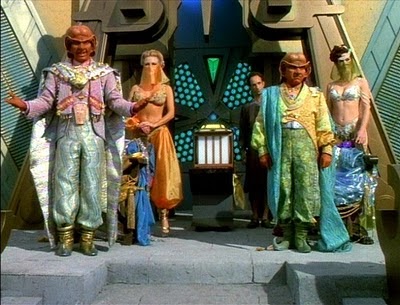
Greed at its Extreme: Perhaps Jefferson's concern was captured best by the fictional Star Trek characters, the Ferengi, who are known for their enterprising savvy to the point that they are con-artists. In the Star Trek Voyager episode “False Profits”, Figure 1, the enterprising Ferengi posed as gods and established their Code of Ethics based on the Ferengi Rules of Acquisition, a Bible of sorts, that have principles of economic vanity. Are humans on Earth to become like the Ferengi on Takar?  Will the next tyranny be corporate demi-gods in a socialized economy after capitalism dies? 


On planet Earth, humans must come to terms with the purpose and meaning of their existence. Living by Rules of Acquisition or strong economic vanity, like the Ferengi, reduces life to an economic venture, mere pennies on the dollar.  Humans should reconsider the meaning of work as a component of their lives but not the defining doctrines in their life. Economic affluence, wealth, is not available to all humans. Most humans live a modest life and have other focuses in life.

Interestingly, Jefferson saw commerce as a source of good and a fabric of a capitalist society that lead to the sense of national happiness found in the Declaration of Independence. However, Jefferson stopped short of social justice and viewed merchants as having no loyalty to a country or moral system (Mayer, 1994, pp. 137-138).  America is at a juncture. The question is will America retain the capitalist views of the founding or become some sort of socialized economic center of influence? Will our gods become enterprising tycoons and their sense of ethics? Goerge Soros, a billionaire and philanthropist,  remarks that he saw no point in having a god until he became one.  Will your ethics, morals, and principles be determined by your paycheck? How much control over you will you give your employer?

Janis Joplin, for all her drug-induced shortcomings, prolifically sang in her song Me and Bobby McGee, "Freedom's just another word for nothing left to lose." 

References:

Federer, W. (1996). America's god and country: encyclopedia of quotations.  Fame Publishing: USA. 

Mayer, D. (1994). The constitutional thought of Thomas Jefferson. University Press of Virginia: USA. 

Menosky, J. & Brozak, G. (Writer) & Bole, C. (Director). (1996). Star trek voyager: false prophets season 3 episode 5. Paramount Television


Thursday, January 30, 2014

Quality As An Effect Means Marketable Value

Comment: This paper was written for a Quality course I took. The instructor challenged us to write creative papers looking at quality in different ways. I choose to write about using Effects Based Outcomes to describe quality as a effect in lieu of a definition.

Abstract: The purpose of this paper is to explore the use of a scientific method to deliver then maintain strategic quality in lieu of an engineered achievement. Engineered solutions include both discrete and perceived quality postures focusing on the production process. This prose argues the use of Effects Based Operations methodology in order to link strategy to quality achieving meaningful outcomes for the organization and the consumer that cannot be achieved in the production process alone. Effects based operations leverage a consumer-centric basis for quality ensuring that the right level of resources is applied for the achievement of the organizational strategy while meeting consumer expectations whether discrete or described as a perception.

Quality as an Effect Means Marketable Value

Discussion: Quality has been a challenge for many organizations to obtain control over and place under reasonable management. Some organizations look at quality as sort of an ethereal ideology, a perception. In these quality organizations  everyone feels the atmosphere of and thinks exceptional quality. For example, everyone strives to meet or exceed the customer expectations or ‘Made in the USA’ means quality or tangible attributes such as weight may translate to quality perceptions. However, expectations are not clearly defined or the location the product is made really does not affect quality or weight is not necessary to achieve quality. Hence, the perceptions of quality. Meanwhile, other organizations travel in the polar opposite direction defining discrete quality and gathering extreme volumes of data to assess the minutest variance in the quality posture. Everyone in this kind of quality organization has assigned quality duties that are identifiable, measurable, and the people are held accountable to the achievement and maintenance of discrete standards. Awards are issued for those who exceed the standards consistently. In the spectrum of quality postures, Figure 1, one extreme is perceived and the other extreme is discrete. Both are definitions being pursued by organizations often with little movement away from one extreme or the other.

Figure 1: The Spectrum of quality postures from 100% perceived to 100% Discrete
The organizational view of quality is often close to the extremes and does not meaningfully or measurably tie organizational strategy to the marketplace view of quality. Yet quality is often considered to be one of the keys to success. The competitive advantage of a company is said to depend on the quality and value of its goods and services, but it has to be proven through ultimate consumer evaluation of the quality (Žnideršić and Marić and Grubor, 2009, p. 170). In traditional terms, quality is a definition, a checkbox item, a measurement, or an intangible look or feel of a product or service exiting out-the-door. This is different than thinking of quality as an effect that warrants a customer to make a purchase.

Quality as an effect means that the end-user reacts to quality that translates to value for the organization such as increased sales, decreased support calls, or increased market penetration. In short, quality as an effect results in competitive advantage for the business and value to the consumer that is deliberate, observed, and measurable. The hypothesis to be explored is if quality can be described as an effect verses a definition then resource-effective quality performance can be achieved that has marketable value. The benefit of such an approach is the deliberate application of the right amount of resources to achieve the expected quality level by the end-user that results in a purchase.

The Body of Works: The body of works regarding quality spans a considerable period. More recent works tended to focus on business models to manage quality in complex circumstances or the introduction of new methods that affect culture. Works regarding Effects Based Operations, EBO, are unique to military operations. Despite EBO emerging well over a decade ago, the works are more recent due to the increased attention to this paradigm.

The business models considered in the body of works include Total Quality Management or TQM; International Standards Organization or ISO-based, and research specific models. Other quality models such as Six Sigma were touched on through elemental practices in the sample body of works. Researchers have looked to business paradigms such as competitive advantage then applied TQM practices with technological innovations to observe how quality is affected. A concept of Business Innovation Capability (BIC) was introduced in order to provide a mechanism that links TQM to innovation. This yielded a competitive advantage for companies who could leverage continuous improvement with continuous innovation (Perdomo-Ortiz and Gonzalez-Benito and Galende, 2009).

Work has also been completed in quality costing benefits of improving performance, quality control, and leveraging competitive advantage. The concern is to accurately cost quality. The researchers determined the need for end-to-end costing systems that provides quality-related financial information and classifications. Researchers provided matrices and formulas to determine costs categories and/or departmental responsibilities (Yang, 2008).

Service quality versus product quality has been studied. Researchers sought to answer the questions that differentiate service quality from product quality, how to approach service quality, and sought to define service quality. Researchers argued that the intangibility of services requires a different approach than physical goods. Quality in services is left more to perception. Researchers then make a call for further study into the complexity and concepts of service quality (Radomir and Plăiaş and Nistor, 2012). In another study on service quality, Researchers looked at competitive advantage as it depends on quality and the value of goods and services that ultimately must pass the consumer evaluation of quality. Researchers concluded that consumers buy the benefits of goods and services offered that include information, emotional components, and other customer perceived value created for them. Researchers point to eleven traits of the customer that companies must pursue (Žnideršić and Marić and Grubor, 2009).

Loyalty is affected by quality according to researchers investigating student choices in higher education. Researchers explored peripheral and situational factors determining that in the student and academic staff relationship quality is critical to loyalty. Overall, the educational quality was perceived and loyalty is a barometer of quality and satisfaction (Purgailis and Zaksa, 2012, p. 148).

Effects based research is indicating a need for standards or doctrine in the effects based practice applied to domestic use. “These [EBO] concepts do offer the possibility of altering the somewhat ad hoc approach to coordinating elements of national power practiced by statesmen and military commanders, to make it a standard operational method (Gladman and Archambault, 2011, p. 24).” Researchers are also discussing how EBO unifies an effort. “Such tools will permit commanders at all levels to monitor effects-based planning performed at subordinate levels to assure that it meets the supported commander’s objectives and desired effects (Elder, 2007, p. 16).”

Work has been completed regarding networks and causal effects on quality. Such networks included various types and populations. This theoretical effort saw the number of firms supporting an emerging technology provided the effect of value to the consumer in terms of information, commitment, and competition. The researchers developed a choice model. They were able to demonstrate the survivability of emerging technology is based on user impressions regarding the number of supporting firms and consumer valuation of size, loyalty, and incumbencies. In the final assessment, the researchers determined that strategic alliances supporting a single emerging technology with incumbent status are valuable partners (Wang & Xie, 2011). Quality was a perceived value based on vendor support of the emerging technology.

Emerging markets posed interesting challenges for business and quality. Researchers discovered that emerging markets are culturally influenced regarding product design and features. The key ability is for a company to combine deep insights about the market place in order to strip out excess costs while amplifying the customer’s true value improving margins and growth in emerging markets (Narayanan and Padhi and Williams, 2012).  Quality is not universal and is culturally influenced. 

In conclusion, the body of works indicates a breadth of research to include standing quality management and business practices in order to achieve business outcomes such as competitive advantage, expanded market share, and improved margins based on the degree of quality. One interesting outcome is that quality can be more perception than specified. Researchers point to perceptions in service quality, loyalty, and culture. Emerging technologies are influenced by perceptions of loyalty and widespread support for products or services before markets embrace them. Strategic alliances improve the survivability of a new technology yielding a perception of the quality of service level.

Studies into effect based operations urge to standardize the methodology while acknowledging the collaborative benefits of EBO. The application of the methodology was to military operations with a little exploration into commercial use. 

The body of works was weak on leveraging quality to achieve planned effects in the marketplace through deliberate strategy-to-task methods which EBO delivers,  This was a second thought in much of the research endeavors and/or a nebulous association affecting outcomes. There were calls for end-to-end cost accounting of quality traits. There was no connection between quality and effects based operation paradigms. Thus, a need for research into methods that link desirable effects to strategy that would offer an end-to-end solution for collaborating on quality projects and create quality as an effect.

Background for Current Research: There have been calls to transform the military and to take advantage of new technologies and methods such as EBO. “Dr. David Alberts describes transformation as a ‘process of renewal, an adaptation to the environment’ (Smith, 2002, pp. xxiv-xxv).” Roger Kaufman of Florida State University comments not to assume that which has worked, will work in the future (Kaufman, 2005, p. 10). Industry should adapt and learn from military paradigms as the emergent marketplace is no longer a simple product or service sale. Consumers buy benefits that goods and services offer and this customer perceived offering is what creates value for them (Žnideršić and Marić and Grubor, 2009, p. 171). As companies seek to blend services and products in order to create value-added solutions forming new markets, these changes affect quality that has become an influencer in market performance. Current trends suggest continuous innovation similar to TQM’s continuous improvements that focus management on total quality in order to promote better customer orientation and workplace integration (Perdomo-Ortiz and Gonzalez-Benito and Galende, 2009, p. 5102). In keeping with the trending, companies should leverage strategic objectives in ways to cause desired effects that enhance both the customer and company benefit.

Researchers have revealed that effects impact markets. The Journal of Marketing published a study of emerging technology market acceptance and willingness to purchase. Researchers concluded that the supporting firm base in relation to product valuation, firm types, and customer interactions most influenced the acceptance of the technology and willingness to buy (Wang and Xie, 2011, p. 11). Quality is part of product valuation. In another study on strategic alignment and new product development, researchers concluded that companies must understand the nature of its competitive environment then based on that understanding, implement a suitable set of alignment mechanisms. Their study evidenced that strategic planning and an innovative climate are key drivers of strategic alignment and new product development performance (Acur and Kandemir and Boer, 2012, p. 313). Hence, a linkage from strategy to objectives then to desired markets effects should be the mechanism that manages and monitors progress.

If quality can be described as a market effect verses a definition or ideology then cost effective quality performance can be achieved that has marketable value. An apparent and inherent need exists for organizations to achieve desired effects in a managed manner in order to align to marketable value. Therefore, a proactive organization that can respond to emergent conditions while adding value or find a competitive advantage has the upper hand to the competition whom become reactive to the affects.

Quality as an Effect: The objective is to explore quality as an effect coupled to the market’s quality perception and/or specification. This requires the use of standing business tactics, techniques, and procedures as well as the introduction of new practices into industry that enhance quality pursuits. This paper proposes the use of EBO found in government in what may be deemed benchmarking between sectors rather than companies. EBO operations provide specific guidelines and processes in order to develop a more collaborative means of acting and thinking (Gladman and Archambault, 2011, p. 24).

The first challenge is to determine the strategy then connect measurable organizational value to that strategy. For the purposes of this research the US Military Joint doctrinal approach to strategy will be employed. The strategy is converted into an actionable mission statement that is further refined by the company’s intent and desired end state, Figure 2. Commander’s intent will be renamed company’s intent in order to place the appropriate focus in this paper. The company’s intent is a statement that narrows action and places constraints as well as restraints on the effort. The end state is a statement of the organization’s desired outcome. The end state has an associated measurable value. In the Table 1 example, the organizational value is (1) the market leader, (2) markets larger than 500,000 people, and (3) market quality expectations. Measurement of the organizational value will be discussed in the section Linking Strategy to Effects.

In comparison between the military and company examples, both structure the strategy in similar manners. The company seeks non-belligerent actions, of course, that promotes favorable conditions for the organization and the customers.

Figure 2: Strategy comparison between military and company examples
In conclusion, having clear strategy at the top of an organization is the beginning of establishing a strategy-to-task effort that leads into EBO planning. This approach should lead into the development of actionable objectives and desired quality effects.

Effects Based Operations: Connecting strategy to actionable tasks has been a challenge for most organizations. Effects Based Operations, EBO, is a method for making this linkage between strategy and tasks.

EBO is a methodology of shaping the behavior in the sphere of operations and is not a new concept tracing back for centuries to what good statesmen and generals have always attempted to do (Smith, 2002, pp. 1-2). In this paper, EBO is applied to leverage quality in ways that create meaningful impact to an organization’s competitive advantage and influence the marketplace favorable to the organization.

There has to be an understanding of what composes an effect. The ‘effect’ is nothing more than a behavioral response to stimuli introduced into a system. EBO is akin to the scientific process of experimentation that has a hypothesis, control variables, and a variable under observation. In business, the hypothesis is strategy and objectives. The control variable, in this case, is quality and the variable under observation is the end users’ behavior.

Organizationally, the process begins by establishing a strategy with objectives. MOV must be coupled to this strategy in order to discern the achievement of the strategic end state that has associated objectives and desired effects or outcomes. Each effect has Measures of Effectiveness, MOE. Each Measures of Effectiveness has indicators that are thresholds for decision points and/or triggers that spawn some sort of action or decision by the organization. Decision points cause a redirection of resources either to the effort or to other efforts. Triggers spawn actions that apply resources or initiate predetermined courses of action. The effects based operational framework flows downward to increased resolution while information flows upward in support of the strategy, Figure 3.

Figure 3: Effects Based Operational associations and information flows
The kinds of measures that can be employed are broad based and include both qualitative and quantitative measures. For example, perceived quality and loyalty can serve as a barometer of satisfaction (Purgailisand Zaksa, 2012, p 148). Other measures can center on the cost of quality. Researchers point to a need for a complete costing system that collects quality related financial information and classifies this data. They went on to offer analytical matrix and formulae to calculate costs (Yang, 2008, p. 190). These matrices and formulae require inputs that can be associated with EBO MOEs.

Researchers investigating consumer evaluation of service quality point to eleven traits that lend well to framing and developing EBO MOEs. They are (1) Understanding the customer, (2) Listening to customers, (3) Prepared to serve the customer, (4) Immediately helping the angry customer, (5) Collecting customer information through permissive means, (6) Living up to commitments, (7) Unsolicited referrals from the customer, (8) Responsible for conduct in front of the customer, (9) Being memorable, (10) Offer pleasant surprises to the customer, (11) Establishing long-term relationships with the customer. These are all about consumer satisfaction and loyalty through managed expectations, experience, and quality (Žnideršić and Marić and Grubor, 2009). The management mechanism should be EBO with customer focused MOEs.

Deliberately linking strategy to low level actions and decisions in a manner consistent with EBO should provide stable management that delivers resource effective quality based on market place perceptions.

Linking Strategy to Quality Based Effects: EBO is deliberately structured to link the effects back to the end state. From the end state, the objectives, effects, and measures of effectiveness as well as indicators and triggers can be determined. The end state in Figure 2 is to be the market leader in Latin American communities larger than 500,000 people who enjoy company products meeting market expectations of quality. From this statement the measurable organizational value is (1) to be the market leader, (2) metropolitan markets larger than 500,000 people, and (3) market quality expectations. There has to be an effort to further define market leader and the markets quality expectations. For demonstration purposes the effects based example, Figure 4, will focus on the quality aspects by providing an illustration of possible market quality EBO.

Taking a closer look at the effects based breakdown, the concept notes provide clarification of the organizational desires as connected to strategy. This is an important aspect for the operator to understand the connection to strategy and the organizations desires. Also note the mixture of qualitative and quantitative traits and how qualitative traits are measured in quantitative terms. This is a major value of the EBO practice that provides for a structured approach to managing strategy-to-tasks. Granted, the effects and measures can be biased and relative. With skill and training these issues can be minimized and leveraged to the advantage of the organization.
Figure 4: Strategy to Effects breakdown example
Conclusion: Mapping strategy to effects and then tasks that contribute toward MOV through strategy-to-task management using EBO framework establishes a deliberate methodology to achieve marketable quality and impact organizational value. Organizational value is simply traits such as conservation of resources, expanded profits, and durable competitive advantage.

Managerial Implications: Managing quality as an effect places the organization in control of outcomes to a greater extent than in the past by focusing rationed resources not to exceed market expectations or benefits to be gained. While quality as an effect is one paradigm, a symbiotic paradigm in organizations must be to design the operations to be responsive and fluid to change by adapting to emergent conditions more readily minimizing quality impacts. Quality as an effect requires a deliberate effort in order to achieve the optimal desired results as opposed to ad hoc approaches consuming immense resources without planned achievements. Sage use of limited funding meeting optimal consumer quality expectations strengthens market performance and frees capital for other projects. In using EBO, companies now will have a tool that stabilizes corporate knowledge and operations while applying resource smartly.

Theoretical Implications and Further Research: The challenge in the research and notion of quality as an effect is in finding the balance between the discrete and perceptive thoughts of quality. While theoretically simple this is not achieved in practice with ease. Research needs to be conducted to determine the methods and practices of revealing a markets placement within the spectrum of quality using transparency.

Complexity also has an essential role in EBO as well. Not only are there intended first order effects but also realized second and third order effects. This means that the outcome is far more complex that a simple cause and effect event. The organization is operating in a complex adaptive environment having emergent conditions that must be dealt with quickly. The necessary character qualities of an organization are a low organizational latency, concise decision-making, and rapid adaptability. This requires an operation to be structured in a manner that is permissive of the necessary level of responsiveness. Therefore, not only is the method of linking Strategy-to-task important but also coupling quality as an effect to an organizational structure supportive of EBO. Research is needed to consider how organizational design influences quality. In short, a quality organization must be designed from ground up and research is required to determine the designs that are effective for the different profit models.

References:

Acur, N., Kandemir, D., & Boer, H. (2012). Strategic Alignment and New Product Development: Drivers and Performance Effects. Journal Of Product Innovation Management, 29(2), 304-318. doi:10.1111/j.1540-5885.2011.00897.

Department of Defense. (2011). Chapter II the art of joint command. Joint Operations, II-1 - II-11, Retrieved from: http://www.dtic.mil/doctrine/new_pubs/jp3_0.pdf.

Elder Jr, R.J. (2007) Effects based operations: a command philosophy. Air and space power journal, 21(1), 10-17.

Foster, S. (2013). Managing quality: integrating the supply chain. (5th e.d.). Pearson: United States of America.

Gladman, B., & Archambault, P. (2011). A Role for Effects-Based Planning in a National Security Framework. Journal Of Military & Strategic Studies, 13(2), 1-26.

Kaufman, R. (2005). Defining and Delivering Measurable Value: A Mega Thinking and Planning Primer. Performance Improvement Quarterly, 18(3), 6-16.

Marchewka, J. (2006). Information technology project management: providing measurable organizational value. John Wiley & Sons, Inc: USA.

Narayanan, A., Padhi, A., & Williams, J. (2012). Designing products for value in emerging markets. (cover story). Mckinsey Quarterly, (4), 46-49.

Perdomo-Ortiz, J., Gonzalez-Benito, J., & Galende, J. (2009). The intervening effect of business innovation capability on the relationship between Total Quality Management and technological innovation. International Journal Of Production Research, 47(18), 5087-5107. doi:10.1080/00207540802070934.

Purgailis, M., & Zaksa, K. (2012). The impact of perceived service quality on student loyalty in higher education institutions. Journal of Business Management, (6), 138-152.

Radomir, l., Plăiaş, i., & Nistor, v. (2012). A Review of the Service Quality Concept - Past, Present and Perspectives. Proceedings Of The International Conference Marketing - From Information To Decision, 5404-427

Schwartz, E. I. (2004). Juice: The Creative Fuel That Drives World-Class Inventors. Harvard Business School Press Books, 1.

Smith, E. (2002). Effects based operations: applying network centric warfare in peace, crisis, and war. CCRP publication series. ISBN 1-893723-08-9

Staszyńska, K. M. (2011). Cognitive Determinants of Data Quality in Public Opinion Polls: Respondents Definition of the Survey. Polish Sociological Review, (176), 493-514.

Summers, J. K., Humphrey, S. E., & Ferris, G. R. (2012). Team Member Change, Flux in Coordination, and Performance: Effects of Strategic Core Roles, Information Transfer, and Cognitive Ability. Academy Of Management Journal, 55(2), 314-338.

Wang, Q., & Xie, J. (2011). Will Consumers Be Willing to Pay More When Your Competitors Adopt Your Technology? The Impacts of the Supporting-Firm Base in Markets with Network Effects. Journal Of Marketing, 75(5), 1-17. doi:10.1509/jmkg.75.5.1.

Yang, C. (2008). Improving the definition and quantification of quality costs. Total Quality Management & Business Excellence, 19(3), 175-191.

Žnideršić, R., Marić, D., & Grubor, A. (2009). CONSUMER EVALUATION OF THE SERVICE QUALITY. Economic Themes, 47(4), 169-185.

Sunday, January 26, 2014

The Democratic Reform Process Model - General Discussion

Comment: A common practice on mine is to baseline my understanding on a topic by writing on it.  This increases my knowledge and is a point to which I return and adjust my knowledge as well.  In addition, my objective was to write in a manner in which others could increase their understanding as well.  I have modified this paper for posting purposes.  The topic originated from the Marshall Plan then through several model revisions and ultimately arriving at the Democratic Reform Process model.  This is one in a set of posts on Democracy:

Community Leadership

Democratic Reform Process Model - In Practice

The Democratic Reform Process Model - General Discussion

Figure 1: DRP Model
The United States encourages Representative Democracy or a Republic and capital economies as a means to elevate human dignity and rights around the globe. Democracy has been the view of the United States as the only form of civil government that can best emplace these virtues. Over time as the United States engages increasing numbers of dissimilar and even hostile cultures, numerous approaches of reforms have emerged resulting in an evolutionary model.  

The current approach to implementing democratic reforms centers on a process model that has an economic backbone. Host nations must willfully build the capacity and capabilities to implement the desirable reforms themselves. The United States partners and in some cases organizes coalitions with the host nation in order to mentor the process. The desired end state is a democratic ally who participates in the global community - economically and politically. 

The book 'Managing Policy Reforms', Figure 1, advances the Democratic Reform Process, DRP,  model as a closed loop feed back model that is a strategic management tool. This model considers the reform process from the perspective of the transitioning country's decision maker challenges and measures of effectiveness indicate progress towards the end state. These challenges commonly center of governance, economic, and the organization's ability to implement the reforms. 

Governance: Host nations often have competitive forms of governance with democracy. Democratic reforms often require anti-corruption campaigns, citizen participation, controls, and judicial restructuring. Sometimes restructuring is not sufficient and complete re-constitution of a new governmental framework is necessary. 

Organizational: In order to support democratic reforms, agencies and systems require a systemic overhaul into an organizational framework that is supportive of the desired reforms. Host nations often simply do not possess the skilled work force, organizational framework, and/or operational process sophistication. Identification of these systemic shortfalls is necessary but action is often constrained due to a lack of financial strength to implement. A strong economic tax base is an underpinning of successful implementation.  

Economic:  Many host nations that have been under repressive or inattentive rule simply have never developed the requisite financial strength necessary to implement full reforms. Barriers in local economies such as graft, corruption, and other adverse conduct prevent economic expansion.  Management programs must be in place to reduce the effects and remove the negative influences if possible.  As a nation's economic strength increases then improvements are notable in terms of human living conditions, dignity, personal incomes, quality of life, and healthcare.

As economic strength increases a ready source of internal revenues become available to fund reforms. Taxation must be carefully managed in order to balance the funds redistributed to economic growth.  In part the temptation for graft and corruption may persist and adversely impact the reforms. 

The basic model of implementing democratic and capitalistic reforms centers on a closed loop feedback system. Progress towards the end state are tracked using measures of effectiveness that relate to governance, economic and organizational centers. In order to develop reforms in a focused center constituencies, legitimization, and resources must be championed as well. 

References:

Brinkerhoff, D.; Crosby, B. (2001). Managing policy reforms: concepts and tools for decision-makers in developing and transitioning countries.  Kumarian press: NY.